The integration of design-oriented approach into corporate management processes
DOI:
https://doi.org/10.14267/VEZTUD.2026.07-08.01Keywords:
design management, design capacity, user-centred design, innovationAbstract
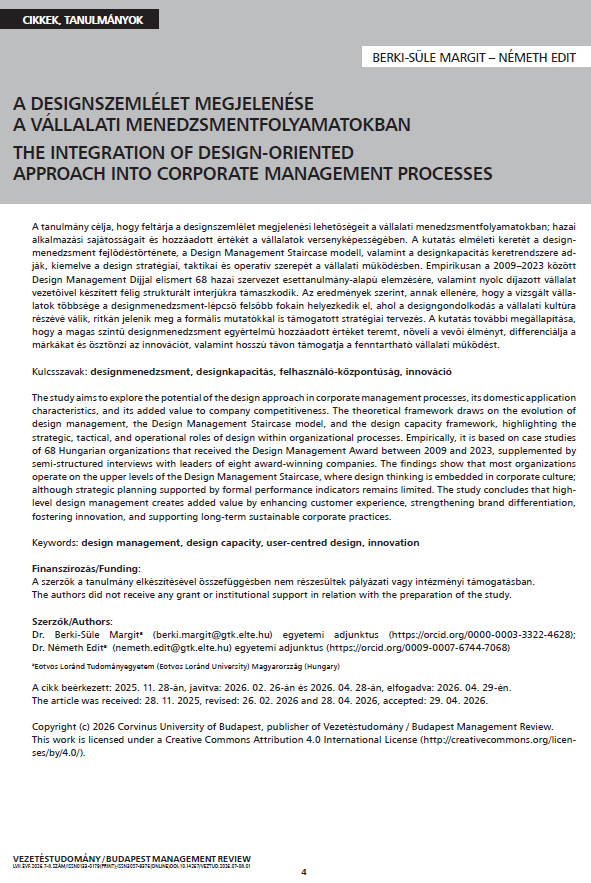
The study aims to explore the potential of the design approach in corporate management processes, its domestic application characteristics, and its added value to company competitiveness. The theoretical framework draws on the evolution of design management, the Design Management Staircase model, and the design capacity framework, highlighting the strategic, tactical, and operational roles of design within organizational processes. Empirically, it is based on case studies of 68 Hungarian organizations that received the Design Management Award between 2009 and 2023, supplemented by semi-structured interviews with leaders of eight award-winning companies. The findings show that most organizations operate on the upper levels of the Design Management Staircase, where design thinking is embedded in corporate culture; although strategic planning supported by formal performance indicators remains limited. The study concludes that highlevel design management creates added value by enhancing customer experience, strengthening brand differentiation, fostering innovation, and supporting long-term sustainable corporate practices.
Downloads
References
Archer, L.B. (2011). A Place for Design in Management Education? In R. Cooper, S. Junginger & T. Lockwood (Eds.), The Handbook of Design Management (pp. 260–275). Bloomsbury Academic. https://doi.org/10.5040/9781474294126
Berki-Süle M. (2018). Designipari termékek hatékony termékfejlesztés-menedzsmentje. In Józsa, L., Korcsmáros, E., & Seres Huszárik, E. (Eds.), A hatékony marketing – EMOK 2018 Nemzetközi Tudományos Konferencia konferenciakötete (pp. 804-815). Selye János Egyetem.
Best, K. (2006). Design Management: managing design strategy, process and implementation. AVA Publishing SA. https://doi.org/10.5040/9781474223522
Bender-Salazar, R. (2023). Design Thinking as an Effective Method for Problem-Setting and Needfinding for Entrepreneurial Teams Addressing Wicked Problems. Journal of Innovation and Entrepreneurship, 12(1), 1-23. https://doi.org/10.1186/s13731.023.00291.2
Borja de Mozota, B. (2002). Design and Competitive Edge: A model for Design Management Excellence in European SMEs. Design Management Journal, 2(1), 88.103. https://doi.org/10.1111/j.1948-7177.2002.tb00014.x
Borja de Mozota, B. (2003). Design Management: using design to build brand value and corporate innovation. Allworth Press. https://doi.org/10.1111/j.1948-7177.2002.tb00014.x
Borja de Mozota, B. (2006). The Four Powers of Design: A Value Model in Design Management. Design Management Review, 17(2), 44.53. https://doi.org/10.1111/j.1948-7169.2006.tb00038.x
Borja de Mozota, B. (2010). A Theoretical Model for Design in Management Science: The Paradigm Shift in the Design Profession, from Management as a Constraint to Management Science as an Opportunity. Design Management Journal, 3(1), 30.37. https://doi.org/10.1111/j.1948-7177.2008.tb00004.x
Borja de Mozota, B., & Wolff, F. (2019). Forty years of research in design management: A review of literature and directions for the future. Strategic Design Research Journal, 12(1), 4-26. https://doi.org/10.4013/sdrj.2019.121.02
Brown, T. (2008). Design thinking. Harvard Business Review, 86(6), 84-92. https://hbr.org/2008/06/design-thinking
Buur, J., & Matthews, B. (2008). Participatory Innovation. International Journal of Innovation Management, 12(3), 255.273. https://doi.org/10.1142/S1363919608001996
Cooper, R., Junginger, S., & Lockwood, T. (2009). Design Thinking and Design Management: A Research and Practice Perspective. Design Management Review, 20(2), 46-55. https://doi.org/ 10.1111/j.1948-7169.2009.00007.x
Cooper, R., & Junginger, S. (2011). General Introduction: Design Management . A Reflection. In R. Cooper, S. Junginger, & T. Lockwood (Eds.), The Handbook of Design Management (pp. 1-32), Bloomsbury Academic. https://doi.org/10.5040/9781474294126
Cooper, R., & Press, M. (1995). The Design Agenda: a guide to successful design management. John Wiley & Sons Ltd. https://doi.org/10.2307/1511736
Cosovan, A., Csordas, T., Horvath, D., Horvath, D., & Mitev, A. (2018). Tervez.i helyzetek jelent.sege a vezet.kepzesben: designkommunikacio es/vagy design thinking. In Jozsa, L., Korcsmaros, E., & Seres Huszarik, E. (Eds.), A hatekony marketing . EMOK 2018 Nemzetkozi Tudomanyos Konferencia konferenciakotete (pp. 902.914). Selye Janos Egyetem.
Dunne, D. (2011). User-centred Design and Design-centred Business Schools. In R. Cooper, S. Junginger, & T. Lockwood (Eds.), The Handbook of Design Management (pp. 128-143), Bloomsbury Academic. https://doi.org/10.5040/9781474294126
Farr, M. (1965). Design management. Why is it needed now? Design Journal, 200, 38-39. https://doi.org/10.5040/9781474294126.ch-002
Gorb, P. (1986). The business of design management. Design Studies, 7(2), 106.110. https://doi.org/10.1016/0142-694X(86)90023-2
Gorb, P. (Ed.) (1990). Design Management: Papers from the London Business School. Press of Architecture Design and Technology.
Heskett, J., & Liu, X. (2012). Models of developing design capacity : perspective from China. In Leading Innovation through Design, DMI International Research Conference (pp. 224-237). DMI.
Horvath, D., Cosovan, A., Horvath, D., & Lachin, N. (2018). Tanulas-munka interface. A valos idej. talalkozasok jelent.sege a digitalis oktatasi kornyezetben. Vezetestudomany, 49(12), 66-77. https://doi.org/10.14267/VEZTUD.2018.12.08
Johansen, B., & Euchner, J. (2013). Navigating the VUCA World. Research-Technology Management, 56(1), 10- 15. https://doi.org/10.5437/08956308X5601003
Joziasse, F. (2011). Design leadership: Current limits and future opportunities. In R. Cooper, S. Junginger, & T. Lockwood (Eds.), The Handbook of Design Management (pp. 398. 413), Bloomsbury Academic. https://doi.org/10.5040/9781474294126
Junginger, S. (2006). Change in the making: Organizational change through human-centered product development (Doctoral dissertation). Carnegie Mellon University.
Kootstra, G. (2009). The incorporation of design management in todayfs business practices. An analysis of design management practices in Europe. Design Management Europe (DME). https://pdfs.semanticscholar.org/8a0e/ec8f3d8b4377d2c1519ef0b982e8e7845b8b.pdf
Kotler, P., & Keller, K.L. (2012). Marketingmenedzsment. Akademiai Kiado. https://doi.org/10.1556/9789630597784 Laamanen, L. (2024). Design Management Perspectives .
Perspectives on Design Management from Finnish Organizations and Practitioners (Masterfs Thesis). School of Arts, Architecture and Design, Aalto University.
Lee, Y., & Joo, J. (2015). How a Design Executive Officer Can Craft an Organizational Culture. Design Management Journal, 10(1), 50-61. https://doi.org/10.1111/dmj.12022
Leonard-Barton. D. (1995). Wellsprings of Knowledge: Building and Sustaining the Source of Innovation. Harvard Business School Press.
Lewis, A., Murphy, D., & Mougenot C. (2009). Overview of Design Management Methodologies. ADMIRE report. University of Wales Institute. https://www.slideshare.net/slideshow/overview-of-design-management-methodologies/71069682&ved=2ahUKEwjEofO455yVAxU6Rv4FHUPOJ-4QFnoECBkQAQ&usg=AOvVaw3MCs65rJc1MXHRCNz8WCbj
Mahmoud-Jouini, S. B., Midler, C., & Silberzahn, P. (2016). Contributions of Design Thinking to Projekt Management in an Innovation Context. Project Management Journal, 47(2), 144-156. https://doi.org/10.1002/pmj.21577
Moritz S. (2005). Service Design: Practical Access to an Evolving Field. Köln International School of Design.
Németh, E., & Hlédik, E. (2018). Tervezői képzések marketing- és menedzsment aspektusai. In Józsa, L., Korcsmáros, E., & Seres Huszárik, E. (Eds.). A hatékony marketing – EMOK 2018 Nemzetközi Tudományos Konferencia konferenciakötete (pp. 915–925). Selye János Egyetem.
Nowacka, A., & Rzemieniak, M. (2022). The Impact of the VUCA Environment on the Digital Competences of Managers in the Power Industry. Energies, 15(1), 185-202. https://doi.org/10.3390/en15010185
Peters, T. (1989). The Design Challenge. Design Management Journal, 1(1), 8–13. https://doi.org/10.1111/j.1948-7169.1989.tb00511.x
Price, R., & Wrigley, C. (2015). Design and a Deep Customer Insight Approach to Innovation. Journal of International Consumer Marketing, 28(2), 1–14. https://doi.org/10.1080/08961530.2015.1092405
Ramlau, U., & Melander, C. (2004). In Denmark, Design Tops the Agenda. Design Management Journal, 15(4), 48–54. https://doi.org/10.1111/j.1948-7169.2004.tb00182.x
Stevens, J.S. (2009). Design as a strategic resource – Design’s contributions to competitive advantage aligned with strategy models (Doctoral dissertation). University of Cambridge for the degree of Doctor of Philosophy.
Stickdorn, M., & Schneider, J. (2010). This is service design thinking. BIS Publishers.
Storvang, P., Jensen, S., & Christensen, P.R. (2014). Innovation through Design: A Framework for Design Capacity in a Danish Context. Design Management Journal, 9(1), 9-22. https://doi.org/10.1111/dmj.12006
Szellemi Tulajdon Nemzeti Hivatala. (2023, Nov 28). Design Management Díj. https://hipo.gov.hu/hu/testuletek/mft/nemzeti-dijak-osztondijak/design-management-dij
The Design Management Institute (dmi). (2016). The Value of Design. https://www.dmi.org/page/DesignValue
Topalian, A. (1986). The Documentation of Corporate Approaches to Design Management to Share Experience and Improve Performance. Engineering Management International, 4(1), 51–60. https://doi.org/10.1016/0167-5419(86)90007-4
Tromp, N. (2013). Social Design – How products and services can help us act in ways that benefit society (Doctoral dissertation). Delft University of Technology.
Turner, R., & Topalian, A. (2002, July). Core responsibilities of design leaders in commercially demanding environments. In Inaugural Session Design Leadership Forum (Vol. 12).
Verganti, R. (2008). Design, Meanings, and Radical Innovation: A Meta Model and a Research Agenda. Journal of Product Innovation Management, 25, 436-456. https://doi.org/10.1111/j.1540-5885.2008.00313.x
Downloads
Published
Issue
Section
License
Copyright (c) 2026 Corvinus University of Budapest, publisher of Vezetéstudomány / Budapest Management Review

This work is licensed under a Creative Commons Attribution 4.0 International License.
Authors assign copyright to Vezetéstudomány / Budapest Management Review. Authors are responsible for permission to reproduce copyright material from other sources.
How to Cite