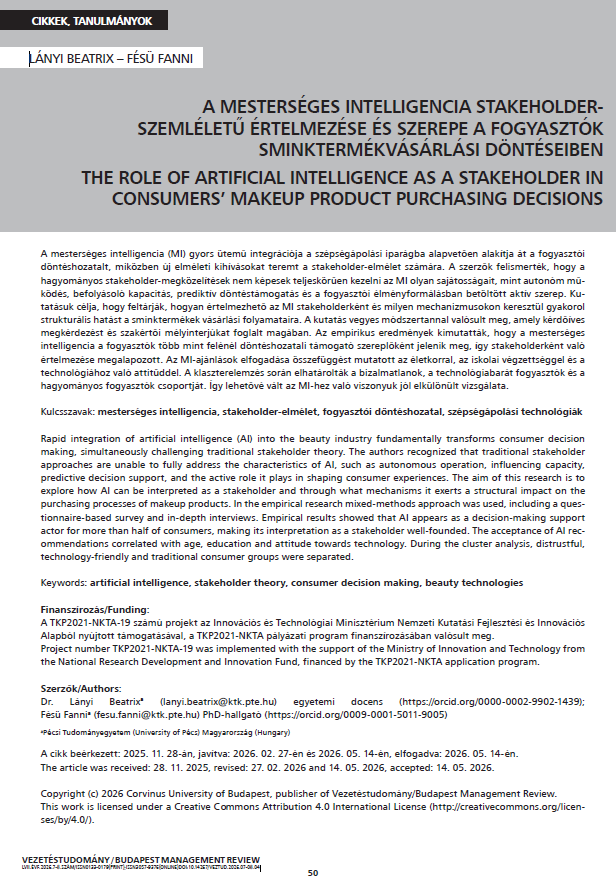
The role of artificial intelligence as a stakeholder in consumers’ makeup product purchasing decisions
DOI:
https://doi.org/10.14267/VEZTUD.2026.07-08.04Keywords:
artificial intelligence, stakeholder theory, consumer decision making, beauty technologiesAbstract
Rapid integration of artificial intelligence (AI) into the beauty industry fundamentally transforms consumer decision making, simultaneously challenging traditional stakeholder theory. The authors recognized that traditional stakeholder approaches are unable to fully address the characteristics of AI, such as autonomous operation, influencing capacity, predictive decision support, and the active role it plays in shaping consumer experiences. The aim of this research is to explore how AI can be interpreted as a stakeholder and through what mechanisms it exerts a structural impact on the purchasing processes of makeup products. In the empirical research mixed-methods approach was used, including a questionnaire-based survey and in-depth interviews. Empirical results showed that AI appears as a decision-making support actor for more than half of consumers, making its interpretation as a stakeholder well-founded. The acceptance of AI recommendations correlated with age, education and attitude towards technology. During the cluster analysis, distrustful, technology-friendly and traditional consumer groups were separated.
Downloads
References
Benlian, A., Titah, R. & Hess, T. (2012). Differential ef fects of provider recommendations and consumer re views in e-commerce transactions: An experimental study. Journal of Management Information Systems, 29(1), 237-272. https://doi.org/10.2753/MIS0742-1222290107
Bosse, D.A., Phillips, R.A. & Harrison, J.S. (2009). Stake holders, reciprocity, and firm performance. Strategic Management Journal, 30(4), 447-456. https://doi.org/10.1002/smj.743
Bosse, D.A., Thompson, S., & Ekman, P. (2023). In con silium apparatus: Artificial intelligence, stakeholder reciprocity, and firm performance. Journal of Business Research, 155, 113402. https://doi.org/10.1016/j.jbusres.2022.113402
Bouhlal, H., & Belahcen, N. (2025). The influence of con versational AI on consumer behavior and counterfac tual thinking: A systematic review. European Scientif ic Journal, 21(4), 69-82. https://doi.org/10.19044/esj.2025.v21n4p69
Chaudhuri, A., & Holbrook M.B. (2001). The chain effects from brand trust and brand affect to brand perfor mance: The role of brand loyalty. Journal of Market ing, 65(2), 81-93. https://doi.org/10.1509/jmkg.65.2.81.18255
Chen, D., Esperança, J.P., & Wang, S. (2022). The impact of artificial intelligence on firm performance: An app lication of the resource-based view to e-commerce fir ms. Frontiers in Psychology, 13, 884830. https://doi.org/10.3389/fpsyg.2022.884830
Cloarec, J. (2020). The personalization–privacy paradox in the attention economy. Technological Forecasting and Social Change, 161, 120299.
Cornell, B., & Shapiro, A.C. (1987). Corporate stakehold ers and corporate finance. Financial Management, 16(1), 5-14. https://doi.org/10.2307/3665543
da Costa, R.L., Gonçalves, R., & Montez, A. (2023). Ar tificial intelligence applied to stakeholder theory. In Pereira, R., Bianchi, I., & Rocha, Á. (Eds.), Digital technologies and transformation in business, industry and organizations: Studies in Systems, decision and control, vol 2. (pp. 101-125). Springer. https://doi.org/10.1007/978-3-031-40710-9_6
Dang, Q. & Li, G. (2025). Unveiling trust in AI: The in terplay of antecedents, consequences, and cultural dy namics. AI & Society, 41, 669-692. https://doi.org/10.1007/s00146-025-02477-6
Delgado-Ballester, E., Munuera-Aleman, J.L. & Yague-Guillen, M.J. (2003). Development and vali dation of a brand trust scale. International Journal of Market Research, 45(1), 35-54. https://doi.org/10.1177/147078530304500103
Dhianita, S., & Rufaidah, P. (2024). The role of virtual try on augmented reality of cosmetic products on purchase intention mediated by brand trust. Jurnal Manajemen Bisnis, 11(2), 1111-1123. https://doi.org/10.33096/jmb.v11i2.797
Donaldson, T., & Preston, L. (1995). The stakeholder the ory of the corporation: Concepts, evidence, and impli cations. Academy of Management Review, 20(1), 65-91. https://doi.org/10.2307/258887
Fang, Y., Liu, S., Wei, K.K., & Zhang, P. (2014). Trust, sat isfaction, and online repurchase intention: The moder ating role of perceived effectiveness of e-Commerce in stitutional mechanisms. MIS Quaterly, 38(2), 407-428. https://doi.org/10.25300/MISQ/2014/38.2.04
Fazi, L., Zaniboni, S., & Wang, M. (2025). Age differences in the adoption of technology at work: A review and recommendations for managerial practice. Journal of Organizational Change Management, 38(8), 138-175. https://doi.org/10.1108/JOCM-12-2024-0767
Figueiredo, J.M.P.C. (2024). The Impact of Artificial Intel ligence on the Stakeholder Theory. ISCTE, University Institute of Lisbon. https://www.proquest.com/open view/913810be54e6ebc98a56253d943d6c41/1?pq-orig site=gscholar&cbl=2026366&diss=y
Freeman, R.E. (1984). Strategic management: A stake holder approach. Pitman Publishing.
Gera, R., & Kumar, A. (2023). Artificial intelligence in consumer behaviour: A systematic literature review of empirical research papers published in marketing journals (2000–2021). Academy of Marketing Studies Journal, 27(S1), 1-15. https://doi.org/10.21203/rs.3.rs-7410830/v1
Hair, J.F., Black, W.C., Babin, B.J., & Anderson, R.E. (2019). Multivariate Data Analysis (8th ed.). Cengage Learning. Hari, H. (2025). Exploring ethical frontiers of artificial in telligence in marketing. Journal of Responsible Tech nology, 15, 100123. https://doi.org/10.1016/j.jrt.2024.100103
Ipsos (2025). Navigating Through Turbulence: Reputation Resilience in Uncertain Times. Ipsos Corporate Rep utation. https://www.ipsos.com/sites/default/files/ct/ publication/documents/2025-05/Ipsos-Reputation-Re silience-In-Uncertain-Times-May2025.pdf
Jan, I.U., Ji, S. & Kim, C. (2023). What (de)motivates customers to use AI-powered conversational agents for shopping? The extended behavioral reasoning per spective. Journal of Retailing and Consumer Services, 75, 103440. https://doi.org/10.1016/j.jretconser.2023.103440
Kelemen-Erdős, A., & Szórát, D.C. (2025). A vállalkozói lehetőségek és a mesterséges intelligencia összefüg gései szisztematikus szakirodalmi áttekintés alapján. Vezetéstudomány, 56(2), 30-44. https://doi.org/10.14267/VEZTUD. 2025.02.03
Li, L., Ali, A., & Guo, M. (2024). Impact of data-based boosting on user click-through intention under AI per sonalized recommendations. Frontiers in Artificial In telligence and Applications, 380, 858-867. https://doi.org/10.3233/ATDE231342
Lavoye, V., Tarkiainen, A., Sipilä, J., & Mero, J. (2023). More than skin-deep: The influence of presence di mensions on purchase intentions in augmented re ality shopping. Journal of Business Research, 169, 114247. https://doi.org/10.1016/j.jbusres.2023.114247
Logg, J.M., Minson, J.A., & Moore, D.A. (2019). Algo rithm appreciation: People prefer algorithmic to hu man judgment. Organizational Behavior and Human Decision Processes, 151, 90-103. https://doi.org/10.1016/j.obhdp.2018.12.005
Matthews, M.J., Su, R., Yonish, L., McClean, S., Koop man, J., & Yam, K.C. (2025). A review of artificial intelligence, algorithms, and robots through the lens of stakeholder theory. Journal of Management, 51(6), 2627-2676. https://doi.org/10.1177/01492063241311855
Micheletto, V., Accardi, S., Fici, A., Piccoli, F., Rossi, C., Bilucaglia, M., Russo, V., & Zito, M. (2025). En joy it! Cosmetic try-on apps and augmented reality, the impact of enjoyment, informativeness and ease of use. Frontiers in Virtual Reality, 6, 1515937. https://doi.org/10.3389/frvir.2025.1515937
Mishra, S., Ewing, M.T., & Cooper, H.B. (2022). Artifi cial intelligence focus and firm performance. Journal of the Academy of Marketing Science, 50(6), 1176 1197. https://doi.org/10.1007/s11747-022-00876-5
Naz, H., & Kashif, M. (2025). Artificial intelligence and predictive marketing: an ethical framework from man agers’ perspective. Spanish Journal of Marketing-ES IC, 29(1), 22-45. https://doi.org/10.1108/SJME-06-2023-0154
Papagiannidis, E., Mikalef, P., & Conboy, K. (2025). Re sponsible artificial intelligence governance: A review and research framework. The Journal of Strategic In formation Systems, 34(2), 101885. https://doi.org/10.1016/j.jsis.2024.101885
Pouloudi, A., & Whitley, E.A. (2000). Representing hu man and non-human stakeholders: On speaking with authority. In Baskerville, R., Stage, J., & DeGross, J.I. (Eds.), Organizational and social perspectives on in formation technology (pp. 339-354). Springer. https://doi.org/10.1007/978-0-387-35505-4_20.
Rai, A., Constantinides, P., & Sarker, S. (2019). Editor’s comments: Next-generation digital platforms: To ward human–AI hybrids. MIS Quarterly, 43(1), iii-ix. https://misq.umn.edu/misq/article-pdf/43/1/iii/6315/0_ edcomments_v43_i1.pdf
Reisinger, D., Reisinger, V., & Nagy, J. (2022). A mestersé ges intelligencia és a digitalizáció hatása a logisztikai munkakörökre: Veszélyben vannak-e a munkahelyek? Vezetéstudomány, 53(8-9), 103-114. https://doi.org/10.14267/VEZTUD.2022.08-09.08
Riandhi, A.N. (2025). AI and consumer behavior: Trends, technologies and implications. Cogent Business & Management, 12(1), 2544984, https://doi.org/10.1080/23311975.2025.2544984
Saári, R. (2016). A stakeholder-kapcsolatok jellemzőinek vizsgálata kis- és középvállalati környezetben. In Ta nulmánykötet – Vállalkozásfejlesztés a XXI. század ban, VI. (pp. 283-296). Óbuda University, Keleti Fa culty of Business and Management.
Sekri, K., Bouzaabia, O., Rzem, H., & Juárez-Varón, D. (2025). Effects of virtual try-on technology as an in novative e-commerce tool on consumers’ online pur chase intentions. European Journal of Innovation Management, 28(8), 4041-4060. https://doi.org/10.1108/EJIM-05-2024-0516
Schindler, D., Maiberger, T., Koschate-Fischer, N., & Hoy er, W. (2024). How speaking versus writing to conver sational agents shapes consumers’ choice and choice satisfaction. Journal of the Academy of Marketing Sci ence, 52(3), 634-652. https://doi.org/10.1007/s11747-023-00987-7
Sikó, B. (2025). Az online viselkedésalapú hirdetések át fogó szisztematikus szakirodalmi áttekintése. Vezetés tudomány, 56(5), 41-56. https://doi.org/10.14267/VEZTUD. 2025.05.04
Statista.com. (2025). Beauty and personal care market value worldwide from 2020 to 2030, by category (in billion U.S. dollars). https://www.statista.com/mar kets/415/topic/467/cosmetics-personal-care/?srslti d=AfmBOordOdkPEciADvrtdZB_Tt0-tSpoGTlPV f9OcFIvb-oX14YKUlHj#statistic1
Thakur, C. (2025). Exploring the influence of generative AI on consumer experiences and behavioral respons es: A systematic literature review and future research agenda. Academy of Marketing Studies Journal, 29(6), 1-41.
Tungkhang, K., & Rroy, A. D. (2025). AI in consumer de cision making: A study on impact of AI on cosmetic products. International Journal for Multidisciplinary Research, 7(5), 1-16. https://doi.org/10.36948/ijfmr.2025.v07i05.56143
Younger, R. (2024). AI is not just a technology. It has be come a stakeholder. Oxford Answers, Said Business School, University of Oxford. https://www.sbs.ox.ac. uk/oxford-answers/ai-not-just-technology-it-has-be come-stakeholder
Wamba-Taguimdje, S. L., Fosso Wamba, S., Kala Kam djoug, J. R., & Tchatchouang Wanko, C. E. (2020). Influence of artificial intelligence (AI) on firm per formance: the business value of AI-based transforma tion projects. Business Process Management Journal, 26(7), 1893-1924. https://doi.org/10.1108/BPMJ-10-2019-0411
Winarto, L., & Wisesa, A. (2025). Analyzing the impact of artificial intelligence and sustainability on Gen Z consumer purchase intentions: A case study of L’Oréal cosmetics Indonesia, 2024. European Journal of Busi ness and Management Research, 9(5), 16-30. https://doi.org/10.24018/ejbmr.2024.9.5.2241
Wu, C.W., & Monfort, A. (2023). Role of artificial intelli gence in marketing strategies and performance. Psy chology and Marketing, 40(3), 484-496. https://doi.org/10.1002/mar.21737
Downloads
Published
Issue
Section
License
Copyright (c) 2026 Corvinus University of Budapest, publisher of Vezetéstudomány / Budapest Management Review

This work is licensed under a Creative Commons Attribution 4.0 International License.
Authors assign copyright to Vezetéstudomány / Budapest Management Review. Authors are responsible for permission to reproduce copyright material from other sources.
How to Cite