Architects and architectural engineers as dual-role stakeholders in the innovation value chain of offsite construction technologies
DOI:
https://doi.org/10.14267/VEZTUD.2026.07-08.02Keywords:
innovation resistance, offsite construction technologies, architects, innovation value chain, innovation, Resistance Theory (IRT), stakeholder communication, educationAbstract
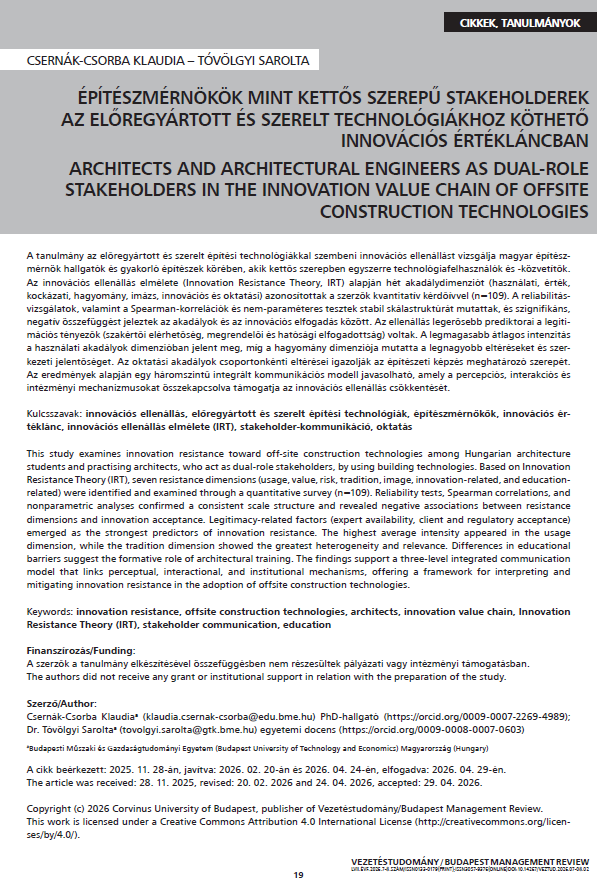
This study examines innovation resistance toward off-site construction technologies among Hungarian architecture students and practising architects, who act as dual-role stakeholders, by using building technologies. Based on Innovation Resistance Theory (IRT), seven resistance dimensions (usage, value, risk, tradition, image, innovation-related, and educationrelated) were identified and examined through a quantitative survey (n=109). Reliability tests, Spearman correlations, and nonparametric analyses confirmed a consistent scale structure and revealed negative associations between resistance dimensions and innovation acceptance. Legitimacy-related factors (expert availability, client and regulatory acceptance) emerged as the strongest predictors of innovation resistance. The highest average intensity appeared in the usage dimension, while the tradition dimension showed the greatest heterogeneity and relevance. Differences in educational barriers suggest the formative role of architectural training. The findings support a three-level integrated communication model that links perceptual, interactional, and institutional mechanisms, offering a framework for interpreting and mitigating innovation resistance in the adoption of offsite construction technologies.
Downloads
References
Aghion, P., Antonin, C., Bunel, S., & Jaravel, X. (2021). The impact of regulation on innovation. IZA Discussion Paper No. 14082. https://docs.iza.org/dp14082.pdf
Agapiou, A. (2022). Barriers to offsite construction adoption: A quantitative study among housing associations in England. Buildings, 12(3), 283. https://doi.org/10.3390/buildings12030283
Alhawamdeh, M., & Lee, A. (2024). A systematic review and meta-synthesis of the barriers of offsite construction projects. International Journal of Construction Management, 25(4), 1-13 https://doi.org/10.1080/15623599.2024.2397287
Atkinson, R., & Flint, J. (2001). Accessing hidden and hard-to-reach populations: Snowball research strategies. Social Research Update, 33. University of Surrey. https://sru.soc.surrey.ac.uk/SRU33.PDF
Bailetti, T., Tanev, S., & Keen, C. (2020). What makes value propositions distinct and valuable to new companies committed to scale rapidly? Technology Innovation Management Review, 10(6), 14-27. https://www.timreview.ca/sites/default/files/article_PDF/TIMReview_2020_June%20-%202_0.pdf
Bayhan, G., & Karaca, O. (2020). Technological innovation in architecture and engineering education—An investigation on three generations from Turkey. International Journal of Educational Technology in Higher Education, 17, 1-22. https://doi.org/10.1186/s41239-020-00207-0
BME Építőművészeti Doktori Iskola. (2024). Építészet & Oktatás (DLA tanulmánykötet). Budapesti Műszaki és Gazdaságtudományi Egyetem. https://dla.epitesz.bme.hu/storage/2024/05/dlabook_1_spreads_x.pdf
Borka, A. (2025). SIP panelek és favázas készházak: gyors építés vs. természetes alapanyagok. ÉVOSZ–MAKÉSZ. https://evosz-makesz.hu/sip-panelek-es-favazas-keszhazak-gyors-epites-vs-termeszetes-alapanyagok/
Chourasia, A., Singhal, S., & Manivannan (2023). Prefabricated volumetric modular construction: A review on current systems, challenges and future prospects. Practice Periodical on Structural Design and Construction, 28(4). https://doi.org/10.1061/PPSCFX.SCENG-1185
Claudy, M.C., Garcia, R., & O’Driscoll, A. (2014). Consumer resistance to innovation—A behavioral reasoning perspective. Journal of the Academy of Marketing Science, 43(4), 528-544. https://doi.org/10.1007/s11747-014-0399-0
Csernák-Csorba, K., & Tóvölgyi, S. (2025). Changing Consumer Preferences in the Prefabricated Housing Sector in Hungary: Construction Companies’ Experiences and Statistical Data on Consumer Behaviour. Periodica Polytechnica Social and Management Sciences, 33(2), 191-199. https://doi.org/10.3311/PPso.37361
DeVellis, R.F. (2017). Scale development: Theory and applications (4th ed.). Sage. European Comission, Directorate-General for Internal Market, Industry, Entrepreneurship and SMEs. (2025). Market potential of offsite construction for housing supply (Publication No. ET-01-25-129-EN-N). Publications Office of the European Union. https://doi.org/10.2873/3569150
European Parliament & Council. (2024, April 24). Directive (EU) 2024/1275 of the European Parliament and of the Council on the energy performance of buildings (recast). Official Journal of the European Union. https://eur-lex.europa.eu/eli/dir/2024/1275/oj/eng
Fabrigar, L.R., & Wegener, D.T. (2011). Requirements for and decisions in choosing exploratory common factor analysis. In Fabrigar, L.R., & Wegener, D.T. (Eds.), Exploratory Factor Analysis (pp. 19-38). Oxford University Press. https://doi.org/10.1093/acprof:osobl/9780199734177.003.0002
Field, A. (2018). Discovering statistics using IBM SPSS Statistics (5th ed.). Sage.
Freeman, R.E. (2010). Strategic management: A stakeholder approach (Reissue ed.). Cambridge University Press. https://doi.org/10.1017/CBO9781139192675
Goodier, C.I., & Gibb, A.G.F. (2007). Future opportunities for offsite in the UK. Construction Management and Economics, 25(6), 585-595. https://doi.org/10.1080/01446190601071821
Gronostajska, B., & Berbesz, A. (2021). Innovations in architectural education in terms of mobile and prefabricated light structures. Global Journal of Engineering Education, 23(2), 93-100. https://www.wiete.com.au/journals/GJEE/Publish/vol23no2/03-Gronostajska-B.pdf
Guo, F., & Li, Z. (2022). A study of collaborative innovation mechanism of prefabricated construction enterprises. Frontiers in Built Environment, 8, 858650. https://doi.org/10.3389/fbuil.2022.858650
Ha, K., & Park, Y.S.S. (2024). Toward a conceptualization of stakeholder business communication. Business Communication Research and Practice, 7(1), 7-16. https://doi.org/10.22682/bcrp.2024.7.1.7
Hamza, M., Azfar, R.W., Mazher, K.M., Sultan, B., Maqsoom, A., Khahro, S.H., & Memon, Z.A. (2023). Exploring perceptions of the adoption of prefabricated construction in Sweden. Sustainability, 15(10), 8281. https://doi.org/10.3390/su15108281
Heidenreich, S., & Kraemer, T. (2016). Innovations— Doomed to fail? Investigating strategies to overcome passive innovation resistance. Journal of Product Innovation Management, 33(3), 277-297. https://doi.org/10.1111/jpim.12273
Hidegkuti, I. (2019). Pszichometriai és statisztikai alapok. Debreceni Egyetem. https://psycho.unideb.hu/sportpszichodiagnosztika/fejezetek/hi_pszichometriai/_book/
Hollebeek, L.D., Urbonavicius, S., Sigurdsson, V., Clark, M.K., Parts, O., & Rather, R.A. (2022). Stakeholder engagement and business model innovation value. The Service Industries Journal, 42(1-2), 1-17. https://doi.org/10.1080/02642069.2022.2026334
Howells, J. (2024). Innovation intermediaries in a digital paradigm: A theoretical perspective. Technovation, 129, 102889. https://doi.org/10.1016/j.technovation.2023.102889
Janurikné Soltész, E. (2023). Nemzetközi trendek az építészképzésben a pandémia után. Magyar Építőipar, 72(3), 6-12. https://ojs.magyarepitoipar.com/index.php/MEI/article/download/2023-3-6/2023-3-6/38
Kalbarczyk, A., Rodriguez, D.C., Mahendradhata, Y., Sarker, M., Seme, A., Majumdar, P., Akinyemi, O.O., Kayembe, P., & Alonge, O.O. (2021). Barriers and facilitators to knowledge translation activities within academic institutions in low- and middle-income countries. Health Policy and Planning, 36(5), 728-739. https://doi.org/10.1093/heapol/czaa188
Kim, H.W., & Kankanhalli, A. (2009). Investigating user resistance to information systems implementation: A status quo bias perspective. MIS Quarterly, 33(3), 567- 582. https://aisel.aisnet.org/misq/vol33/iss3/9/
Kim, K.P., Connolly, T., Ryschka, S., Dosky, A., & Stefanopoulos, A. (2023). The implication of digital twin technology toward improving the perception of modular houses in Australia. International Journal of Sustainable Building Technology and Urban Development, 14(2), 285-296. https://doi.org/10.22712/susb.20230021
Labib, A. & Abdelsattar, A. (2025). Examining the impact of construction field trips on students’ learning outcomes. Education Sciences, 15(5), 562. https://doi.org/10.3390/educsci15050562
Long, J.C., Cunningham, F.C., & Braithwaite, J. (2013). Bridges, brokers and boundary spanners in collaborative networks: A systematic review. BMC Health Services Research, 13, Article 158. https://doi.org/10.1186/1472-6963-13-158
Loureiro, S.M.C., Romero, J., & Bilro, R.G. (2020). Stakeholder engagement in co-creation processes for innovation. Journal of Business Research, 119, 388-409. https://doi.org/10.1016/j.jbusres.2019.09.038
McCord, K.H., Dillon, H.E., Hu, A., Carlson, S., Phillips, A.R., Jung, Y.J., Gunderson, P., Tarufelli, B., & Antonopoulos, C.A. (2025). Comparative life cycle assessment of a modular cross-laminated timber residential building designed for disassembly and reuse versus traditional wood frame construction. Journal of Cleaner Production, 462, 140941. https://doi.org/10.1016/j.jclepro.2025.146541
MÉK. (2022). A Magyar Építész Kamara Elnökségének stratégiai célkitűzései 2021–2025. https://www.mek.hu/media/files/2022/kiadvanyok/strategia_teljes_web.pdf
Moorthy, K., Ling, C.S., Fatt, Y.W., Yee, C.M., Yin, E.C.K., Yee, K.S., Wei, L.K. (2017). Barriers of mobile commerce adoption intention: Perceptions of Generation X in Malaysia. Journal of Theoretical and Applied Electronic Commerce Research, 12(2), 37-53. https://doi.org/10.4067/S0718-18762017000200004
Nikolopoulou, K. (2023, június 22). What is non-probability sampling? | Types & examples. Scribbr. https://www.scribbr.com/methodology/non-probability-sampling/
Parracho, J., de Brito, J., & Silva, R. (2025). Modular construction in the digital age: A systematic review. Buildings, 15(5), 765. https://doi.org/10.3390/buildings15050765
Pallant, J. (2020). SPSS survival manual (7th ed.). McGraw– Hill Education.
Setia, M.S. (2016). Methodology series module 5: Sampling Strategies. Indian Journal of Dermatology, 61(5), 505-509. https://doi.org/10.4103/0019-5154.190118
Putra, F.I.F.S., Haziroh, A.L., Budiantoro, R.A., Lestari, S.P., & Arsanda, T.D. (2023). AMOBA: Innovation barriers of the millennial generation. Asian Management and Business Review, 3(1), 1-13. https://doi.org/10.20885/AMBR.vol3.iss1.art1
Ram, S., & Sheth, J.N. (1989). Consumer resistance to innovations: The marketing problem and its solutions. Journal of Consumer Marketing, 6(2), 5-14. https://doi.org/10.1108/EUM0000000002542
Sergeeva, N., & Liu, N. (2020). Social construction of innovation and the role of innovation brokers in the construction sector. Construction Innovation: Information, Process, Management, 20(2), 247-259. https://doi.org/10.1108/CI-02-2019-0016
Tóth, E. (2018). Építészek az iskolában Konferencia 2017. Magyar Építész Kamara. KultúrAktív Egyesület. https://mek.hu/media/files/2018/letoltheto/konf_layout_2018_04_05.pdf
Vakeva-Baird, S., Tahmasebi, F., Williams, J.J., & Mumovic, D. (2025). Effective interdisciplinary stakeholder engagement in net zero building design. Buildings & Cities, 6(1), 654-673. https://doi.org/10.5334/bc.510
Winkler, C. (2024). Client orchestration for the implementation of energy innovations (Doctoral dissertation). https://www.diva-portal.org/smash/get/diva2:1854258/FULLTEXT01.pdf
Downloads
Published
Issue
Section
License
Copyright (c) 2026 Corvinus University of Budapest, publisher of Vezetéstudomány / Budapest Management Review

This work is licensed under a Creative Commons Attribution 4.0 International License.
Authors assign copyright to Vezetéstudomány / Budapest Management Review. Authors are responsible for permission to reproduce copyright material from other sources.
How to Cite