The impact of leadership style on SME performance
DOI:
https://doi.org/10.14267/VEZTUD.2025.10.03Keywords:
SME, leadership style, performance, systematic literature review, empirical researchAbstract
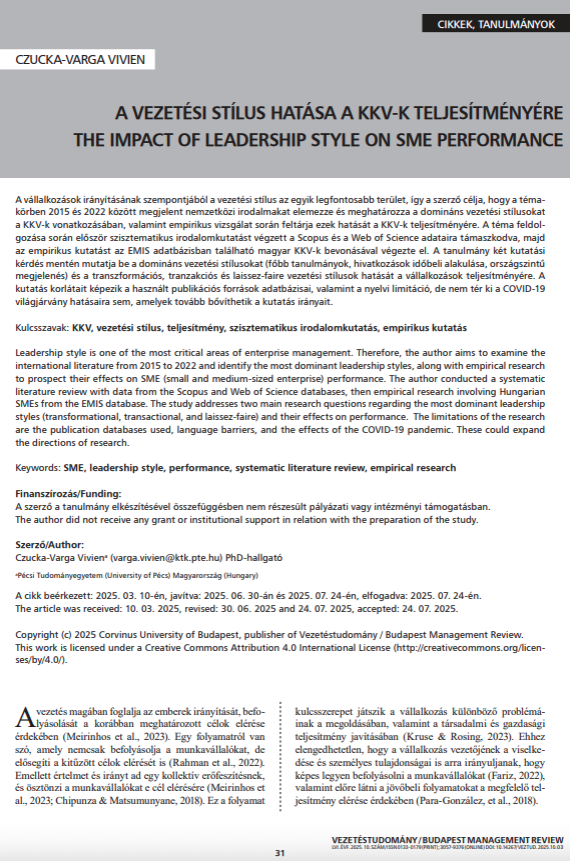
Leadership style is one of the most critical areas of enterprise management. Therefore, the author aims to examine the international literature from 2015 to 2022 and identify the most dominant leadership styles, along with empirical research to prospect their effects on SME (small and medium-sized enterprise) performance. The author conducted a systematic literature review with data from the Scopus and Web of Science databases, then empirical research involving Hungarian SMEs from the EMIS database. The study addresses two main research questions regarding the most dominant leadership styles (transformational, transactional, and laissez-faire) and their effects on performance. The limitations of the research are the publication databases used, language barriers, and the effects of the COVID-19 pandemic. These could expand the directions of research.
Downloads
References
Al-Subaie, A.A., Faisal, M.N., Aouni, B., & Jabeen, F. (2021). Investigating the role of leadership styles and governance on project performance in megaprojects. Polish Journal of Management Studies, 23(1), 45-58. http://dx.doi.org/10.17512/pjms.2021.23.1.03
Amoah, J., Belás, J., Khan, K.A., & Metzker, Z. (2021). Antecedents of sustainable SMEs in the social media space: A partial least square-structural equation modeling (PLS-SEM) approach. Management & Marketing-Challenges for the Knowledge Society, 16(1), 26-46. http://dx.doi.org/10.2478/mmcks-2021-0003
Avolio, B.J., & Bass, B.M. (2002). Developing potential across a full range of leadership. Lawrence Erlbaum Associates.
Avolio, B.J., & Gardner, W.L. (2005). Authentic leadership development: Getting to the root of positive forms of leadership. The Leadership Quarterly, 16(3), 315-338. http://dx.doi.org/10.1016/j.leaqua.2005.03.001
Bass, B.M., & Avolio, B.J. (1997). Revised manual for the Multifactor Leadership Questionnaire. Mind Garden.
Bányai, E., & Sipos, N. (2019). Aktualitások a felsővezetői kiválóság területén. Vezetéstudomány, 50(1), 63-69. http://dx.doi.org/10.14267/VEZTUD.2019.01.06
Beltrame, F., Floreani, J., Grassetti, L., Mason, M.C., & Miani, S. (2018). Collateral, mutual guarantees and the entrepreneurial orientation of SMEs. Management Decision, 57(1), 168-192. http://dx.doi.org/10.1108/MD-11-2017-1077
Bencsik, A. (2021). Vezetői felkészültség felmérése a digitális kor kihívásaira: Nemzetközi összehasonlítás. Vezetéstudomány, 52(4), 93–108. https://doi.org/10.14267/VEZTUD.2021.04.08
Burns, J.M. (1978). Leadership. Harper & Row.
Cantermi, B.D.A., & Lizote, S.A. (2022). Leadership and organizational culture in small companies. Revista de Administração da UFSM, 15(4), 634-656. http://dx.doi.org/10.5902/1983465970384
Carrión, I.A.D., Ramírez, M.C.L., & Flores, J.C.M. (2018). Transformational leadership and gender in 4 and 5 star hotels in Tijuana (Mexico). Cuadernos de Turismo, 42, 137-160. https://revistas.um.es/turismo/article/view/353431/252811
Chammas, C.B., & Hernandez, J.M.D.C. (2019). Comparing transformational and instrumental leadership: The influence of different leadership styles on individual employee and financial performance in Brazilian startups. Innovation & Management Review, 16(2), 143-160. http://dx.doi.org/10.1108/INMR-08-2018-0064
Chipunza, C., & Matsumunyane, L.L. (2018). Motivation sources and leadership styles among middle managers at a South African university. SA Journal of Human Resource Management, 16(1), 1-13. http://dx.doi.org/10.4102/sajhrm.v16i0.985
Deshwal, V., & Ali, M.A. (2020). A systematic review of various leadership theories. Shanlax International Journal of Commerce, 8(1), 38-43. http://dx.doi.org/10.34293/commerce.v8i1.916
Dobák, M., & Antal, Zs. (2016). Vezetés és szervezés: Szervezetek kialakítása és működtetése. Akadémia Kiadó.
Doeleman, H.J., van Dun, D.H., & Wilderom, C.P. (2022). Leading open strategizing practices for effective strategy implementation. Journal of Strategy and Management, 15(1), 54-75. http://dx.doi.org/10.1108/JSMA-09-2020-0253
Dvorsky, J., Belas, J., Gavurova, B., & Brabenec, T. (2021). Business risk management in the context of small and medium-sized enterprises. Economic Research-Ekonomska Istraživanja, 34(1), 1690-1708. http://dx.doi.org/10.1080/1331677X.2020.1844588
Erat, S., Kitapçı, H., & Akçin, K. (2020). Managerial perception and organizational identity: a comparative analysis. Sustainability, 12(6), 2278. http://dx.doi.org/10.3390/su12062278
Fariz, F. (2022). The effect of supplier integration, manager transformational leadership on supply chain performance. Uncertain Supply Chain Management, 10(3), 993-998. http://dx.doi.org/10.5267/j.uscm.2022.2.014
Filep, R. (2018). Vezetési stílus vizsgálata MLQ segítségével a Szabolcs-Szatmár-Bereg megyei kisvállalkozások körében. International Journal of Engineering and Management Sciences, 3(4), 36-47. http://dx.doi.org/10.21791/IJEMS.2018.4.5.
Fischer, H., Heidler, P., Coco, L., & Albanese, V. (2022). Leadership theories and the veterinary health care system. Veterinary Sciences, 9(10), 538. http://dx.doi.org/10.3390/vetsci9100538
Freihat, S. (2020). The role of transformational leadership in reengineering of marketing strategies within organizations. Problems and Perspectives in Management, 18(4), 364-375. http://dx.doi.org/10.21511/ppm.18(4).2020.29
Gerő, H.E.J., Kincses, Á., & Tóth, G. (2021). A hazai mikro-, kis- és középvállalkozások térbeli jellegzetességei. Területi Statisztika, 61(6), 769-796. https://doi.org/10.15196/TS610604
Goleman, D. (1995). Emotional intelligence: Why it can matter more than IQ. Bantam Books.
Győri, Á., Lengyel, G., & Perpék, É. (2020). Preferált vezetési stílus, vezetői és vállalkozói hajlandóság az egyetemi hallgatók körében. Metszetek-Társadalomtudományi folyóirat, 9(1), 3-26. https://doi.org/10.18392/metsz/2020/1/1
Hamza, K.A., Alshaabani, A., Salameh, N., & Rudnak, I. (2022). Impact of transformational leadership on employees’ reactions to change and mediating role of organizational trust: Evidence from service companies in Hungary. Problems and Perspectives in Management, 20(2), 522-535. http://dx.doi.org/10.21511/ppm.20(2).2022.43
Hansen, J.A., & Pihl-Thingvad, S. (2019). Managing employee innovative behaviour through transformational and transactional leadership styles. Public Management Review, 21(6), 918-944. http://dx.doi.org/10.1080/14719037.2018.1544272
Hargreaves, A., & Fink, D. (2004). The seven principles of sustainable leadership. Educational Leadership, 61(7), 8-13. https://jotamac.typepad.com/jotamacs_weblog/files/seven_principles.pdf
Hussain, S.T., Lei, S., Akram, T., Haider, M.J., Hussain, S.H., & Ali, M. (2018). Kurt Lewin’s change model: A critical review of the role of leadership and employee involvement in organizational change. Journal of Innovation & Knowledge, 3(3) 123-127. http://dx.doi.org/10.1016/j.jik.2016.07.002
Ishii, K., Takemura, Y., & Ichikawa, N. (2021). Relationships between the components of nurse managers’ transformational leadership and organisational learning subprocesses in a hospital ward: A cross‐sectional study. Journal of Nursing Management, 29(4), 672-680. http://dx.doi.org/10.1111/jonm.13203
Jarjabka, Á., Köő, N., Varga, V., & Kuráth, G. (2022). Menedzsmentkihívások az újranyitás után a felsőoktatásban a Pécsi Tudományegyetem gyakorlati példája alapján. In Kőműves, Zs.S., Dajnoki, K., Pató, G.Sz.B., Poór, J., Szabó, K., Szabó-Szentágotai, G., & Szabó, Sz. (Eds.), Kilábalás – Újranyitás – Növekedés Poszt-COVID-szindróma és bizonytalan helyzet menedzsment szempontjai. Akadémia Kiadó.
Joiner, B., Josephs, S. (2007). Leadership Agility; Five Levels of Mastery for Anticipating and Initiating Change. Wiley & Sons.
Kispál-Vitai, Zs., (2013). Szervezeti viselkedés. Pearson.
Központi Statisztikai Hivatal (2024). 9.1.1.17. Összefoglaló tábla. A vállalkozások teljesítménymutatói kis- és középvállalkozási kategória szerint. https://www.ksh.hu/stadat_files/gsz/hu/gsz0018.html
Kruse, P., & Rosing, F. (2023). An experimental investigation of perceived differences in personality and leadership attributes of social entrepreneurs compared to for profit entrepreneurs and non-profit organisations leaders. The Journal of Entrepreneurship, 32(1), 75-110. http://dx.doi.org/10.1177/09713557231160332
Kumar, S. (2018). Servant Leadership: A Review of Literature. Pacific Business Review International, 11(1), 43-50. https://opensiuc.lib.siu.edu/context/ojwed/article/1008/viewcontent/Servant_Leadership.pdf
Kuráth, G., & Bányai, E. (2024). Vezetőfejlesztés a 21. században. Akadémia Kiadó.
Kusa, R., Duda, J., & Suder, M. (2021). Explaining SME performance with fsQCA: The role of entrepreneurial orientation, entrepreneur motivation, and opportunity perception. Journal of Innovation & Knowledge, 6(4), 234-245. http://dx.doi.org/10.1016/j.jik.2021.06.001
Lewin, K., Lippit, R., & White, R.K. (1975). Agresszív viselkedési sémák kísérletileg kialakított társas légkörben, In Csoportdinamika (pp. 159-191). Közgazdasági és Jogi Könyvkiadó.
Machi, L.A., & McEvoy, B.T. (2012). The literature review: Six steps to success. Corwin Press.
Meekaewkunchorn, N., Szczepańska-Woszczyna, K., Muangmee, C., Kassakorn, N., & Khalid, B. (2021). Entrepreneurial orientation and SME performance: The mediating role of learning orientation. Economics & Sociology, 14(2), 294-312. http://dx.doi.org/10.14254/2071-789X.2021/14-2/16
Meirinhos, G., Cardoso, A., Neves, M., Silva, R., & Rêgo, R. (2023). Leadership styles, motivation, communication and reward systems in business performance. Journal of Risk and Financial Management, 16(2), 70. http://dx.doi.org/10.3390/jrfm16020070
Messmann, G., Evers, A., & Kreijns, K. (2022). The role of basic psychological needs satisfaction in the relationship between transformational leadership and innovative work behavior. Human Resource Development Quarterly, 33(1), 29-45. http://dx.doi.org/10.1002/hrdq.21451
Obaid, S., Ahmad, S.F., & Mumtaz, F. (2022). Ability-motivation- opportunity framework: An analysis of interrelated effects of HRM practice and leadership style on organizational outcomes. International Journal of Asian Business and Information Management (IJABIM), 13(1), 1-26. http://dx.doi.org/10.4018/IJABIM.309105
OECD. (2016). Financing SMEs and Entrepreneurs 2016: An OECD Scoreboard. OECD Publishing. https://doi.org/10.1787/fin_sme_ent-2016-en
Page, M.J., McKenzie, J.E., & Bossuyt, P.M. (2021). The PRISMA 2020 statement: an updated guideline for reporting systematic reviews. BMJ, 372, http://dx.doi.org/10.1136/bmj.n71
Para-González, L., Jiménez-Jiménez, D., & Martínez-Lorente, A.R. (2018). Exploring the mediating effects between transformational leadership and organizational performance. Employee Relations, 40(2), 412-432. http://dx.doi.org/10.1108/ER-10-2016-0190
Paul, J., Lim , W.M., O’Cass, A., Hao, A.W., & Bresciani, S. (2021). Scientific procedures and rationales for systematic literature reviews (SPAR‐4‐SLR). International Journal of Consumer Studies, 45(4), O1-O16. http://dx.doi.org/10.1111/ijcs.12695
Pintér, R. (2023). The digital maturity of Hungarian small and medium sized enterprises: The Digimeter index: research results. Vezetéstudomány/Budapest Management Review, 54(10), 66–75. https://doi.org/10.14267/VEZTUD.2023.10.06
Rahman, S., Islam, M.Z., Hossain, M., Abdullah, D.A., & Jasimuddin, S.M. (2022). Organizational Factors, ICT Support, and Affective Commitment: The Case of Bangladesh-Based Service Organizations. Journal of Global Information Management (JGIM), 30(1), 1-18. http://dx.doi.org/10.4018/JGIM.302914
Rao-Nicholson, R., Khan, Z., Akhtar, P., & Merchant, H. (2016). The impact of leadership on organizational ambidexterity and employee psychological safety in the global acquisitions of emerging market multinationals. The International Journal of Human Resource Management, 27(20), 2461-2487. http://dx.doi.org/10.1080/09585192.2016.1204557
Szerb, L., & Hornyák, M., (2016). A magyar kisvállalatok versenyképességének vizsgálata regionális összehasonlításban. In Lengyel, I. & Nagy, B. (Eds.), Térségek versenyképessége, intelligens szakosodása és újraiparosodása (pp. 307-325). JATEPress.
Szerb, L., Rideg, A., Kruzslicz, F., & Márkus, G. (2020). Kompetencia-alapú versenyképesség-mérés és-elemzés a magyar kisvállalati (mKKV) szektorban. PTEKTK Regionális Innováció és Vállalkozáskutató Központ (RIERC).
Szigeti, T., & Hornyák, M. (2024). Digitális transzformáció a projektmenedzsmentben – rendszerező irodalomkutatás. Marketing & Menedzsment, 58(2), 5-15, http://dx.doi.org/10.15170/MM.2024.58.02.01
Turaeva, G. (2023). The value of leadership in small enterprises from their employees’ perspective. Vezetéstudomány/ Budapest Management Review, 54(5), 41–50. https://doi.org/10.14267/VEZTUD.2023.05.04
Whitmore, J. (2009). Coaching for Performance: Growing Human Potential and Purpose—The Principles and Practice of Coaching and Leadership (4th Edition). Nicholas Brealey Publishing.
Zeike, S., Bradbury, K., Lindert, L., & Pfaff, H. (2019). Digital leadership skills and associations with psychological well-being. International Journal of Environmental Research and Public Health, 16(14), 2628. http://dx.doi.org/10.3390/ijerph16142628
Downloads
Published
Issue
Section
License
Copyright (c) 2025 Corvinus University of Budapest, publisher of Vezetéstudomány / Budapest Management Review

This work is licensed under a Creative Commons Attribution 4.0 International License.
Authors assign copyright to Vezetéstudomány / Budapest Management Review. Authors are responsible for permission to reproduce copyright material from other sources.
How to Cite