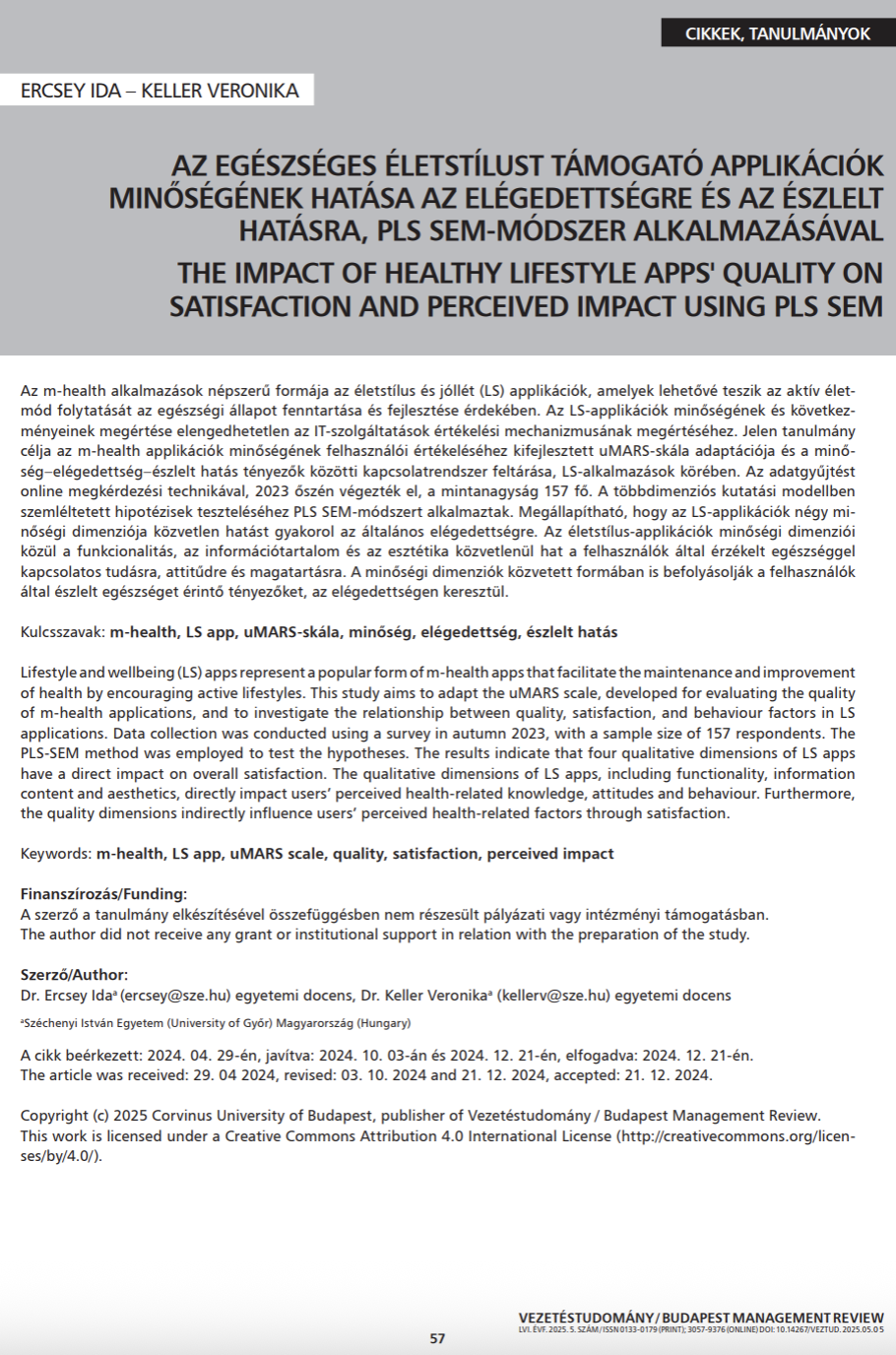
The impact of healthy lifestyle apps' quality on satisfaction and perceived impact using PLS SEM
DOI:
https://doi.org/10.14267/VEZTUD.2025.05.05Keywords:
m-health, LS app, uMARS scale, quality, satisfaction, perceived impactAbstract
Lifestyle and wellbeing (LS) apps represent a popular form of m-health apps that facilitate the maintenance and improvement of health by encouraging active lifestyles. This study aims to adapt the uMARS scale, developed for evaluating the quality of m-health applications, and to investigate the relationship between quality, satisfaction, and behaviour factors in LS applications. Data collection was conducted using a survey in autumn 2023, with a sample size of 157 respondents. The PLS-SEM method was employed to test the hypotheses. The results indicate that four qualitative dimensions of LS apps have a direct impact on overall satisfaction. The qualitative dimensions of LS apps, including functionality, information content and aesthetics, directly impact users’ perceived health-related knowledge, attitudes and behaviour. Furthermore, the quality dimensions indirectly influence users’ perceived health-related factors through satisfaction.
Downloads
References
Agher, D., Sedki, K., Despres, S., Albinet, J., Jaulent, C.M., & Tsopra, R. (2022). Encouraging Behavior Changes and Preventing Cardiovascular Diseases Using the Prevent Connect Mobile Health App: Conception and Evaluation of App Quality. Journal of Medical Internet Research, 24(1), e25384. https://doi.org/10.2196/25384
Akter, Sh., D’Ambra, J., Ray, P., & Hani, U. (2013). Modelling the impact of mHealth service quality on satisfaction, continuance and quality of life. Behaviour & Information Technology, 32, 1225-1241. https://doi.org/10.1080/0144929X.2012.745606.
Andaleeb, S.S. (2001). Service Quality Perceptions and Patient Satisfaction: A Study of Hospitals in a Developing Country. Social Science and Medicine, 52(9), 1359-1370. https://doi.org/10.1016/S0277-9536(00)00235-5
Bettinghaus, E.P. (1986). Health promotion and the knowledge- attitude-behavior continuum. Preventive Medicine, 15(5), 475–491. https://doi.org/10.1016/0091-7435(86)90025-3
Bhattacherjee, A. (2001). Understanding information systems continuance. An expectation–confirmation model. MIS Quarterly, 25(3), 351–370. https://doi.org/10.2307/3250921
Buckingham, S.A, Williams, A.J, Morrissey, K, Price, L, & Harrison. J. (2019). Mobile health interventions to promote physical activity and reduce sedentary behaviour in the workplace: a systematic review. Digit Health, 5, 2055207619839883. https://doi.org/10.1177/2055207619839883
Calik, G., Kartal, B. B., Stoyanov, S., Gravas, S., Othman, L., de la Rosette, J., Albayrak, S., & Laguna, P. (2022). Turkish validation of the user version of the mobile application rating scale. Turkish Journal of Urology, 48(3), 236-242. https://doi.org/10.5152/tud.2022.21324
Chasiotis, G., Stoyanov, S.R., Karatzas, A., & Gravas S. (2023). Greek validation of the user version of the Mobile Application Rating Scale (uMARS). The Journal of International Medical Research, 51(3), 3000605231161213. https://doi.org/10.1177/03000605231161213
Choi, K.S., Cho, W.H., Lee, S., Lee, H. K., & Kim, C. (2004). The relationships among quality, value, satisfaction and behavioural intention in health care provider choice: a South Korean study. Journal of Business Research, 57(8), 913–21. https://doi.org/10.1016/S0148-2963(02)00293-X
Dagger, T.S., Sweeney, J.C., & Johnson, L.W. (2007). A hierarchical model of health service quality: scale development and investigation of an integrated model. Journal of Service Research, 10(2), 123–142. https://doi.org/10.1177/1094670507309594
Dagger, T.S., & Sweeney, J.C. (2006). The effect of service evaluations on behavioural intentions and quality of life. Journal of Service Research, 9(1), 3–18. https://doi.org/10.1177/1094670506289528
Davis, A., & Ellis, R. (2019). A quasi-experimental investigation of college students’ ratings of two physical activity mobile apps with varied behavior change technique quantity. Digit Health, 27(5), 2055207619891347. https://doi.org/10.1177/2055207619891347
Dijkstra, K.T., & Henseler, J. (2015). Consistent and asymptotically normal PLS estimators for linear structural equations. Computational Statistics & Data Analysis, 81, 10–23. https://doi.org/10.1016/j.csda.2014.07.008
Direito, A., Carraça, E., Rawstorn, J., Whittaker, R., & Maddison, R. (2017). mHealth technologies to influence physical activity and sedentary behaviors: behavior change techniques, systematic review and metaanalysis of randomized controlled trials. Annals of Behavioral Medicine: a publication of the Society of Behavioral Medicine, 51(2), 226–239. https://doi.org/10.1007/s12160-016-9846-0
Early, J., Gonzalez, C., Gordon-Dseagu, V., & Robles-Calderon L. (2019). Use of mobile health (mhealth) technologies and interventions among community health workers globally: A scoping review. Health Promotion Practice, 20(6), 805–817. https://doi.org/10.1177/1524839919855391
Ercsey, I. & Keller, V. (2023). Az életstílus applikációk használatának megítélése egy kísérlet tapasztalatai alapján. Marketing & Menedzsment, 57(Különszám EMOK 1), 23–32. https://doi.org/10.15170/MM.2023.57
Fedele, D.A., Cushing, C.C., Fritz, A., Amaro, C.M., & Ortega, A. (2017). Mobile health interventions for improving health outcomes in youth: a meta-analysis. JAMA Pediatrics, 171(5), 461–69. https://doi.org/10.1001/jamapediatrics.2017.0042
Firth, J., Torous, J., Nicholas, J., Carney, R., Rosenbaum, S., & Sarris J. (2017). Can smartphone mental health interventions reduce symptoms of anxiety? A meta- analysis of randomized controlled trials. Journal of Affective Disorders, 218, 15–22. https://doi.org/10.1016/j.jad.2017.04.046
Girasek, E., Boros, J., Döbrössy, B., Susánszky, A., & Győrffy, Z. (2022). E-páciensek Magyarországon: Digitális egészséggel kapcsolatos ismeretek, szokások egy országos reprezentatív felmérés tükrében. Orvosi Hetilap, 163(29), 1159-1165. https://doi.org/10.1556/650.2022.32512
Hair, J., & Alamer, A. (2022). Partial Least Squares Structural Equation Modelling (PLS-SEM) in Second Language and Education Research: Guidelines Using an Applied Example. Research Methods in Applied Linguistics, 1, 100027. https://doi.org/10.1016/j.rmal.2022.100027
Hair, J.F., Risher, J.J., Sarstedt, M. & Ringle, C.M. (2019). When to use and how to report the results of PLSSEM. European Business Review, 31(1), 2-24. https://doi.org/10.1108/EBR-11-2018-0203
Henseler, J. (2021). Composite-Based Structural Equation Modeling: Analyzing Latent and Emergent Variables. The Guilford Press.
Henseler, J., Hubona, G., & Ray, P.A. (2016). Using PLS path modeling in new technology research: updated guidelines, Industrial Management & Data Systems, 116(1), 2-20. https://doi.org/10.1108/IMDS-09-2015-0382
Iribarren, S.J., Schnall, R., Stone, P.W., & Carballo-Dieguez, A. (2016). Smartphone applications to support tuberculosis prevention and treatment: review and evaluation. JMIR MHealth Uhealth, 4(2), e25. https://doi.org/10.2196/mhealth.5022
Kemény, I., Kulhavi, N., & Kun, Zs. (2022). A távorvoslás igénybevételét befolyásoló tényezők a COVID-19 járvány miatti félelem tükrében. Statisztikai Szemle, 100(1), 7-43. https://doi.org/10.20311/stat2022.1.hu0007
Kovács, T., & Várallyai, L. (2021). Egészségügyi mobilapplikációkra történő használati szándék mérése UTAUT-modellben: tanulmány egy online felmérés eredményei alapján. Információs Társadalom: Társadalomtudományi Folyóirat, 21(1), 166-187. http://doi.org/10.22503/inftars.XXI.2021.1.7
Kovácsné Tóth, Á., Ercsey, I., & Keller, V. (2023). Az életmód applikációk használatának akadályai egy feltáró kutatás tapasztalatai alapján. Egészségfejlesztés, 64(2), 17-29. https://doi.org/10.24365/ef.12109
Lányi, B., & Törőcsik, M. (2022). Az e-egészségügyi megoldások fogyasztói fogadtatása Magyarországon. Vezetéstudomány, 53(7), 63-78. https://doi.org/10.14267/VEZTUD.2022.07.06
Li, Y., Ding, J., Wang, Y., Tang, C., & Zhang, P. (2019). Nutrition-Related Mobile Apps in the China App Store: Assessment of Functionality and Quality. JMIR Mhealth Uhealth, 7(7), e13261. https://doi.org/10.2196/13261
Limayem, M., Hirt, S.G., & Cheung, C.M.K. (2007). How habit limits the predictive power of intention: the case of information systems continuance. MIS Quarterly, 31(4), 705–737. https://doi.org/10.2307/25148817
Martinez-Perez, B., de la Torre-Diez, I., & Lopez-Coronado, M. (2015). Experiences and results of applying tools for assessing the quality of a mHealth app named Heartkeeper. Journal of Medical Systems, 39(11), 142. https://doi.org/10.1007/s10916-015-0303-6
Martin-Payo, R., Carrasco-Santos, S., Cuesta, M., Stoyan, S., Gonzalez-Mendez, X., & Fernandez-Alvarez, M.D.M. (2021). Spanish adaptation and validation of the User Version of the Mobile Application Rating Scale (uMARS). Journal of the American Medical Informatics Association: JAMIA, 28(12), 2681–2686. https://doi.org/10.1093/jamia/ocab216
Morselli, S., Sebastianelli, A., Domnich, A., Bucchi, C., Spatafora, P., Liaci, A., Gemma, L, Gravas, S., Panatto, D., Stoyanov, S., Serni, S., & Gacci, M. (2021). Translation and validation of the Italian version of the user version of the Mobile Application Rating Scale (uMARS). Journal of Preventive Medicine and Hygiene, 62(1), E243-E248. https://doi.org/10.15167/2421-4248/jpmh2021.62.1.1894
Nagy, Á., Kemény, I., Szűcs, K., Simon, J., & Kehl, D. (2019). A véleményformáló magatartás mint másodrendű látens változó modellezése PLS-alapú strukturális egyenletek módszerével. Statisztikai Szemle, 97(9), 827–854. https://doi.org/10.20311/stat2019.9.hu0827
Overdijkink, S.B., Velu, A.V., Rosman, A.N., van Beukering, M.D., Kok, M., & Steegers-Theunissen, R.P. (2018). The usability and effectiveness of mobile health technology-based lifestyle and medical intervention apps supporting health care during pregnancy: systematic review. JMIR mHealth uHealth, 6(4), e109, https://doi.org/10.2196/mhealth.8834
Peek, J., Hay, K., Hughes, P., Kostellar A., Kumar S., & Bhikoo, Z. (2021). Feasibility and Acceptability of a Smoking Cessation Smartphone App (My QuitBuddy) in Older Persons: Pilot Randomized Controlled Trial. JMIR Formative Research, 5(4), e24976. https://doi.org/10.2196/24976
Powell, A.C., Torous, J., Chan, S., Raynor, G.S., Shwarts, E., Shanahan, M., & Landman, A.B. ( 2016). Interrater reliability of mHealth app rating measures: analysis of top depression and smoking cessation apps. JMIR Mhealth Uhealth, 4(1), e15. https://doi.org/10.2196/mhealth.5176
Ren, S.M., & Li, L.J. (2010). Application of knowledge-attitude- behavior three level of target theory model in health education of patients with breast tumors. Journal of Nursing Science, 16, 1308–1309.
Schang, L., Blotenberg, I., & Boywitt, D. (2021). What makes a good quality indicator set? A systematic review of criteria. International Journal for Quality in Health Care: Journal of the International Society for Quality in Health Care, 33(3), 1–10. https://doi.org/10.1093/intqhc/mzab107
Schnall, R., Rojas, M., Bakken, S., Brown, W., Carballo- Dieguez, A., Carry, M., Gelaude, D., Mosley, J. P., & Travers, J. (2016). A user-centered model for designing consumer mobile health (mHealth) applications (apps). Journal of Biomedical Informatics, 60, 243–51. https://doi.org/10.1016/j.jbi.2016.02.002
Seddon, P.B. (1997). A respecification and extension of the DeLone and McLean model of IS success. Information Systems Research, 8(3), 240–53. https://doi.org/10.1287/isre.8.3.240
Shinohara, Y., Yamamoto, K., Ito, M., Sakata, M., Koizumi, S., Hashisako, M., Sato, M., Wannous, M., Stoyanov, S.R., Nakajima, J., & Furukawa, T.A. (2022). Development and validation of the Japanese version of the umars (user version of the Mobile App Rating System). International Journal of Medical Informatics, 165, 104809, https://doi.org/10.1016/j.ijmedinf.2022.104809
Silva, B.M.C., Rodrigues, J.J.P.C., de la Torre Dıez, I., Lopez-Coronado, M., & Saleem, K. (2015). Mobile- health: a review of current state in 2015. Journal of Biomedical Informatics, 56, 265–72. https://doi.org/10.1016/j.jbi.2015.06.003
Simon, J. (2016). Marketing az egészségügyben. Akadémiai Kiadó.
Statista. (2024a). Statista Market Insights, Digital Health – Hungary, Users. https://www.statista.com/outlook/dmo/digital-health/hungary?currency=usd#users
Statista. (2024b). Statista Market Insights, Digital Health – Hungary, Key Players. https://www.statista.com/outlook/hmo/digital-health/hungary#key-players
Stoyanov, S.R., Hides, L., Kavanagh, D.J, & Wilson, H. (2016). Development and validation of the user version of the mobile application rating scale (uMARS). JMIR mHealth uHealth. 4(2), e72. https://doi.org/10.2196/mhealth.5849
Stoyanov, S.R., Hides, L., Kavanagh, D.J., Zelenko, O., Tjondronegoro, D., & Mani, M. (2015). Mobile app rating scale: a new tool for assessing the quality of health mobile apps. JMIR Mhealth Uhealth, 3(1), e27, https://doi.org/10.2196/mhealth.3422
Whittaker, R., McRobbie, H., Bullen, C., Rodgers, A., Gu, Y., & Dobson, R. (2019). Mobile phone text messaging and app-based interventions for smoking cessation. Cochrane Database Systematic Review, 10(10), CD006611. https://doi.org/10.1002/14651858.CD006611.pub5
Woodside, A.G., Frey, L.L., & Daly, R.T. (1989). Linking service quality, customer satisfaction, and behavioural intention. Journal of Health Care Marketing, 9(4), 5 –17.
Yu-Ting, Y., Yong-Wei, Y., Miao, Y., Qiong, Y., Meng-Yu, W., & Ting, L. (2023). Knowledge, attitude, behaviour, and influencing factors of home-based medication safety among community-dwelling older adults witchronic diseases: a cross-sectional study. BMC Geriatrics, 23(1), 256. https://doi.org/10.1186/s12877-023-03966-3
Zapata, B.C., Fernandez-Aleman, J.L., Idri, A., & Toval, A. (2015). Empirical Studies on Usability of mHealth Apps: A Systematic Literature Review. Journal of Medical Systems, 39(2). https://doi.org/10.1007/s10916-014-0182-2
Zhao, S.H., Zhang, M.H., & Wang, Y.N. (2011). Effects of Knowledge-Attitude-Behavior health education mode on improvement of oral drug compliance in patients with epilepsy. Journal of Nursing Science, 26, 84–85.
Downloads
Published
Issue
Section
License
Copyright (c) 2025 Corvinus University of Budapest, publisher of Vezetéstudomány / Budapest Management Review

This work is licensed under a Creative Commons Attribution 4.0 International License.
Authors assign copyright to Vezetéstudomány / Budapest Management Review. Authors are responsible for permission to reproduce copyright material from other sources.
How to Cite