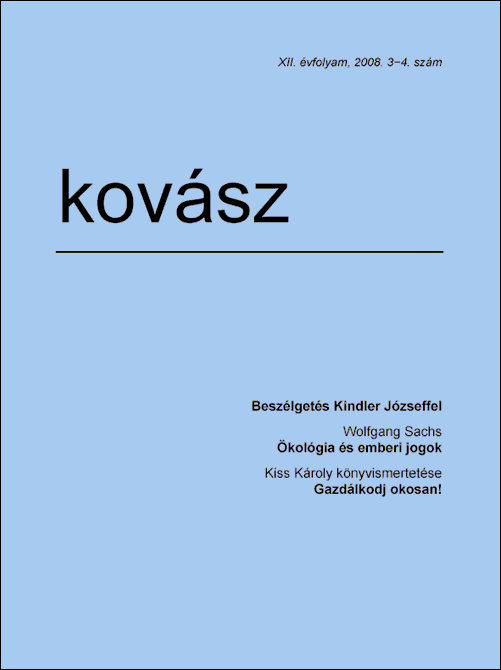
Wolfgang Sachs: Ökológia és emberi jogok
DOI:
https://doi.org/10.14267/kov.20083e2Kulcsszavak:
szegénység, igazságosság, létfenntartás, emberi jogokAbsztrakt
Jövőképes globalizációról csak akkor beszélhetünk, ha a határokat nem ismerő gazdasági folyamatok nem terhelik túl a véges alkalmazkodóképességű bioszférát és nem állják útját a nagyobb igazságosság iránti igényeknek a világban. De mi a környezeti igazságosság nemzetközi összefüggésben? Az igazságosságnak általában háromféle értelmezése lehet: igazságosság mint méltányosság, igazságosság mint egyenlő elosztás, valamint igazságosság mint emberi méltóság. Az első eset az összes résztvevő számára fair szervezeti kereteket jelent, amelyek az előnyöket és a hátrányokat elosztják; ez a procedurális igazságosságfelfogás. A második eset a javak és jogok arányos elosztása egyének vagy csoportok között; ez a relációs igazságosságfelfogás. A harmadik eset pedig az emberhez méltó élethez szükséges javak és jogok minimuma, ez az abszolút (vagy szubsztantív) igazságosságfelfogás. Cikkünk e harmadik értelemben, emberi jogi kérdésként fejti ki a nemzetek közötti környezeti igazságosságot. Elsőként felvázol hat jellegzetes helyzetet, amelyekben az erőforrás-használat módszerei ellentétesek a létfenntartás jogaival: a nyersanyagok bányászata, az ökológiai rendszerek átalakítása, az élőlények átprogramozása, az éghajlatváltozás okozta instabilitás, a városi élettér szennyezése és az erőforrásárak hatásai mind ezt példázzák. Ezt követően az emberi jogokról szóló vitát tárgyaljuk, különös tekintettel a létfenntartási jogokra, amelyek részei a gazdasági, szociális és kulturális emberi jogoknak. Végül néhány kiindulópontot adunk egy emberi jogokra épülő környezetpolitika kialakításához, melynek célja, hogy a polgári jogokat mindenki számára garantálja egy véges bioszférában. Nem az államok közötti hatalmi vetélkedésnek vagy a gazdasági versengésnek kell a kialakuló világtársadalom meghatározó vonásának lennie, hanem az emberi jogok kiteljesedésének és a bioszféra iránti gondoskodásnak.
Hivatkozások
AA (2000): Osservazioni sull’agricoltura geneticamente modificata e sulla degradazione delle spezie; Bollati Boringhieri, Torino
Agarwal, A. − Narain, S. (1991): Towards Green Villages. A Strategy for Environmentally Sound and Participatory Rural Development; CSE, New Delhi
Braßel, F. − Windfuhr, M. (1995): Welthandel und Menschenrechte; Dietz, Bonn
Brunkhorst, H. (2002): Die Politik der Menschenrechte. Verfas sungsfragen in der fragmentierten Weltgesellschaft; Blätter für deutsche und internationale Politik 8, 981–991.
Byrne, J. − Glover, L. − Martinez, C. (2002) (szerk.): Environmental Justice: Discourses in International Political Economy; Transaction Books, New Brunswick
Gadgil, M. − Guha, R. (1995): Ecology and Equity − The Use and Abuse of Nature in Contemporary India; Routledge, London
Haller, T. − Blöchlinger, A. − John, M. − Marthaler E. − Ziegler, S. (2000): Fossile Ressourcen, Erdölkonzerne und indigene Völker; Focus, Giessen
Hardoy, J. − Mitlin, D. − Satterthwaite, D. (2001): Environmental Problems in an Urbanizing World; Earthscan, London
IFG (International Forum on Globalization) (2002): Interim Report −Intrinsic Consequences of Economic Globalization on the Environment; IFG, San Francisco
Ignatieff, M. (2001): Human Rights as Politics and as Idolatry; Princeton University Press, Princeton
IPCC (Intergovernmental Panel on Climate Change) (2001): Climate Change 2001 − Impacts, Adaptation and Vulnerability. A Contribution of Working Group II to the Third Assessment Report; Cambridge University Press, Cambridge
Kant, I. (1985): Zum ewigen Frieden. Ein philosophischer Entwurf (1775); Stuttgart (magyarul: Az örök béke; Európa Könyvkiadó, Budapest, 1985, Babits Mihály fordítása)
Kothari, S. (1996): Whose Nation? The Displaced as Victims of Development; Economic and Political Weekly, június 15., 1476–1485.
Krebs, A. (2002): Arbeit und Liebe. Die philosophischen Grundlagen sozialer Gerechtigkeit; Suhrkamp, Frankfurt
Lohman, L. − V. Sampson, V. (2000): Genetic Dialectic. The Biological Politics of Genetically Modified Trees; Cornerhouse Briefing 21, Sturminster Newton
MacKay, F. (2002): The Rights of Indigenous Peoples in International Law; Zarsky, L. (szerk.): Human Rights and the Environment; Earthscan, London, 9−30.
Martinez-Alier, J. (2002): The Environmentalism of the Poor. A Study of Ecological Conflicts and Valuation; Edward Elgar, Cheltenham
Mehta, G. (1993): A River Sutra; Viking, New Delhi
Müller-Plantenberg, U. (2000): Rawls weltweit; Prokla 30, H. 121, http://www.jahrbuch-lateinamerika.de/rawls.htm (2009. január 21-i állapot szerint)
Onuma, Y. (1998): An Intercivilizational Approach to Human Rights; in. Nuscheler, F. (szerk.): The International Debate on Human
Rights and the Right to Development; INEF-Report 30., Institut für Entwicklung und Frieden, Duisburg, 5–47.
OHCHR (Office of the UN High Commissioner on Human Rights) (2002): Draft Guidelines − A Human Rights Approach to Poverty Reduction Strategies; Geneva, http://www.unhchr.ch/development/povertyfinal.html (2009. január 21-i állapot szerint)
Parry M. et al. (2001): Millions at Risk. Defining Critical Climate Change Threats and Targets; Global Environmental Change 11, 3, 181–183.
Pogge, T. (2002): World Poverty and Human Rights; Polity Press, Cambridge
Pogge, T. (2003): Ein Dollar pro Tag. Von den Schwierigkeiten, die Weltarmut zu berechnen; Neue Zürcher Zeitung, január 4.
Raina, V. − Chowdhury A. − Chowdhury S. (1999) (szerk.): The Dispossessed. Victims of Development in Asia; Arena Press, Hongkong
Rajagapol, B. (2001): The Violence of Development; The Washington Post, augusztus 8.
Ramos, M. L. (2002): Resistance to GMO’s in Centres of Origin −The Case of the Bolivian Potato; in. Friends of the Earth International (szerk.): Fertile Resistance in Agrobiodiversity; FOEI, Brussels, augusztus, 19–20. http://www.foei.org/en/publications/pdfs/agro_eng2.pdf (2009. január 21-i állapot szerint)
Roy, A. (1999): Das Ende der Illusion. Politische Einmischungen; Blessing, München
Sachs, W. (szerk.) (1992): Wie im Westen so auf Erden. Ein polemisches Handbuch zur Entwicklungspolitik; Rowohlt, Reinbek
Sachs, W. et al. (2002): Das Jo’burg Memo. Ökologie – die neue Farbe der Gerechtigkeit; Memorandum zum Weltgipfel für Nachhaltige Entwicklung, Heinrich-Böll-Stiftung, Berlin, http://www.worldsummit2002.org/publications/memo_dt_without.pdf (2009. január 21-i állapot szerint)
Sachs, W. (2002): Nach uns die Zukunft. Der globale Konflikt um Gerechtigkeit und Ökologie; Brandes&Apsel, Frankfurt
Sánchez, José − Silveira, M. − Améndola, C. (2002): Resisting Cheap Imports and „Market Liberalization“ − the Case of Lima Bean Growers in Uruguay; in. Friends of the Earth International (szerk.): Fertile Resistance in Agrobiodiversity; augusztus, Brussels, 21−25., http://www.foei.org/en/publications/pdfs/agro_eng2.pdf (2009. január 21-i állapot szerint)
Shue, H. (1980): Basic Rights. Subsistence, Affluence and U.S. Foreign Policy; Princeton University Press, Princeton
Steiner, H. J. − Alston, Philip (1996) (szerk.): International Human Rights in Context − Law, Politics, Morals; Oxford University Press, Oxford
Stonich, S. C. − De La Torre, I. (2002): Farming Shrimps, Harvesting Hunger − The Costs and Benefits of the Blue Revolution; http://www.foodfirst.org/en/node/54 (2009. január 21-i állapot szerint)
UNDP (United Nations Development Programme) (1998): Human Development Report 1998; Oxford University Press, Oxford, http://hdr.undp.org/en/reports/global/hdr1998/chapters/ (2009. január 21-i állapot szerint)
UNDP (United Nations Development Programme) (2000): Briefing papers for students − Human rights; http://www0.un.org/cyberschoolbus/briefing/rights/rights.pdf (2009. január 21-i állapot szerint)
UNDP (United Nations Development Programme) (2001): Human Development Report 2001; Oxford University Press, Oxford, http://hdr.undp.org/en/media/completenew1.pdf (2009. január 21-i állapot szerint)
UNEP (United Nations Environment Programme) (2002): Global Environmental Outlook 3; Earthscan, London, http://www.unep.org/geo/geo3 (2009. január 21-i állapot szerint)
Wadle, S. (2002): The Long March for Livelihoods − Struggle Against the Narmada Dam in India; in. J. Byrne et al. (szerk.): Environmental Justice; Transaction Books, New Brunswick, 71–96.
WCD (World Commission on Dams) (2000): Dams and Development; Earthscan, London, http://www.dams.org/report/contents.htm (2009. január 21-i állapot szerint)
WCFSD (World Commission on Forests and Sustainable Development) (1999): Our Forests, Our Future; Cambridge University Press, Cambridge, http://www.iisd.org/pdf/wcfsdsummary.pdf (2009. január 21-i állapot szerint)
WCED (World Commission on Environment and Development) (1987): Our Common Future; Oxford University Press, Oxford http://www.un-documents.net/wced-ocf.htm (2009. január 21-i állapot szerint) (magyarul: Közös jövőnk; Mezőgazdasági Könyvkiadó, Budapest, 1988)
WRI (World Resources Institute) (2000): World Resources 2000–2001 − People and Ecosystems; WRI, Washington, http://pdf.wri.org/world_resources_2000-2001_people_and_ecosystems.pdf (2009. január 21-i állapot szerint)
Letöltések
Megjelent
Folyóirat szám
Rovat
License
Copyright (c) 2008 Kovász

This work is licensed under a Creative Commons Attribution 4.0 International License.