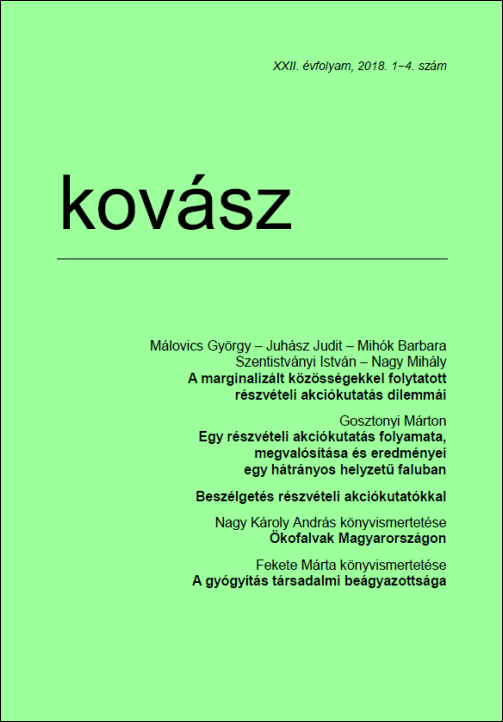
"Csak tíz, húsz... száz év múlva ne ez a dal legyen!" - A marginalizált közösségekkel folytatott részvételi akciókutatás dilemmái
DOI:
https://doi.org/10.14267/kov.2018e1Kulcsszavak:
akciókutatás, mélyszegénység, roma, hátrányos helyzet, részvétel, bevonásAbsztrakt
Jelen tanulmányban rámutatunk a részvételi akciókutatás (RAK) gyakorlati nehézségeire a szegedi roma szegregátumban szerzett tapasztalataink alapján. Hosszú távú célunk, összhangban a RAK elveivel, hogy elősegítsük a mélyszegény roma résztvevők képessé tételét, és ezáltal átalakulást idézzünk elő mind egyéni, mind közösségi szinten. Megvizsgáljuk, hogy a RAK elvei és a fenti célok mennyiben egyeztethetők össze az általunk vizsgált esetben. Bemutatjuk, hogy egy mélyszegény közösségben, illetve előítéletes, elnyomó társadalmi környezettel jellemezhető helyzetben milyen tevékenységek lehetnek szükségesek a képessé tételhez és átalakuláshoz. Megvizsgáljuk a képessé tétel időtávját, a szereplők cél- és értékkülönbségeit, a képessé tétel és átalakulás lehetséges szintjeit, valamint hogy a vonatkozó társadalmi problémák léptéke hogyan befolyásolja a lehetőségeket a képessé tételben és átalakulásban. Következtetésünk, hogy a RAK egy ígéretes megközelítés a mélyszegény közösségek, családok képessé tételében. Ugyanakkor az is egyértelművé vált, hogy a gyakorlatban nehéz megfelelni a RAK részvétellel, átláthatósággal és emancipációval kapcsolatos elméleti követelményeinek.
The present study discusses the difficulties of carrying out participatory action research (PAR) with segregated Roma communities in Szeged (Hungary). The long-term aims of the PAR process are to empower poor and stigmatized Roma participants and support transformation both at the individual and the community level. The paper reports to what extent these goals can be consistent with the ideal principles of PAR, and points out what the activities are that might be necessary for supporting empowerment and transformation in a situation where the social context is characterized by stigmatization and oppression. We reflect on: the time frame of empowerment; the differences in goals and values among participants; the potential levels of empowerment and transformation; and the effects of the scale of social problems on opportunities related to empowerment and transformation. Our conclusion is that (1) PAR is an effective approach for empowering poor and stigmatized families and communities, although (2) it might be rather challenging to live up to the ideal principles of PAR related to participation, transparency and emancipation in practice.
Hivatkozások
Arieli, D.–Friedman, V.J.–Agbaria, K. (2009): The paradox of parti-cipation in action research; Action Research 7 (3), 263–290.
Aziz, A.–Shams, M.–Khan, K. S. (2011): Participatory action research as the approach for women’s empowerment; Action Research 9 (3), 303–323.
Bakacsi Gy. (1996): Szervezeti magatartás és vezetés; Közgazdasá-gi és Jogi Könyvkiadó, Budapest
Bakacsi Gy.–Bokor A.–Császár Cs.–Gelei A.–Kováts K.–Takács S. (1999): Stratégiai emberi erőforrás menedzsment; Közgazdasági és Jogi Könyvkiadó, Budapest
Bodorkós B. (2010): Társadalmi részvétel a fenntartható vidékfejlesz-tésben: a részvételi akciókutatás lehetőségei; Doktori értekezés, Szent István Egyetem, Környezettudományi Doktori Iskola, Gödöllő http://szie.hu//file/tti/archivum/Bodorkos_B_ertekezes.pdf
(2018.12.06-i állapot szerint.)
Bradbury-Huang, H. (2010): What is good action research? Why the resurgent interest? Action Research 8 (1), 93–109.
Clover, D. (2011): Successes and challenges of feminist arts- based participatory methodologies with homeless/street-involved women in Victoria; Action Research 9 (1), 12–26.
Dick, B. (2015): Reflections on the SAGE Encyclopedia of Action Re-search and what it says about action research and its methodologies; Action Research 13 (4), 431–444.
Dillon, M. (2014): A Foucauldian analysis of power relations in an ac-tion research study; Action Research 12 (2), 209–223.
Greenwood, D. J. (2015): An analysis of the theory/concept entries in the SAGE Encyclopedia of Action Research: What we can learn about action research in general from the encyclopedia; Action Research 13 (2), 198–213.
Grill, J. (2012): ‘Going up to England’: Exploring mobilities among Ro-ma from Eastern Slovakia; Journal of Ethnic and Migration Studies 38, 1269–87.
Gustavsen, B. (2014): Social impact and the justification of action re-search knowledge; Action Research 12 (4), 339–356.
Haushofer, J.–Fehr, E. (2014): On the psychology of poverty; Scien-ce, 344, 6186, 862–867.
Johansson, A. W.–Lindhult, E. (2008): Emancipation or workability? Critical versus pragmatic scientific orientation in action research; Ac-tion Research 6 (1), 95–115.
Ladányi J.–Szelényi I. (2004): A kirekesztettség változó formái; Nap-világ Kiadó, Budapest
L’Etang, S.–Theron, L. (2011): A critical reflection on the participatory action process involved in the development of a Cognitive-behaviou-ral based Counselling Intervention Programme for youth living with HIV/AIDS in a rural South African town; Action Research 10 (1), 5–21.
Letiecq, B.–Schmalzbauer, L. (2012): Community-based participatory research with Mexican migrants in a new rural destination: A good fit? Action Research 10 (3), 244–259.
Málovics Gy.–Juhász J.–Méreiné Berki B.–Tóth J. (2017): Kinek a részvétele? Mélyszegény társadalmi csoportok valós részvételi lehe-tősége a helyi fejlesztési döntésekben; In. Bajmócy Z.–Gébert J.–Má-lovics Gy. (szerk.): Helyi gazdaságfejlesztés a képességszemlélet alapján; JATEPress, Szeged, 161–188.
Málovics Gy.–Méreiné Berki B.–Pataki Gy.–Juhász J.–Pálné Mihók B.–Szentistványi I.–Nagy M.–Tóth J. (2018): Confronting espoused theories with theories-in-use: Challenges of participatory action re-search (PAR) with marginalized communities in contributing to social change and theory building; Action Research, megjelenés alatt, http://journals.sagepub.com/doi/abs/10.1177/1476750318774389
Málovics Gy.–Mihók B.–Pataki Gy.–Szentistványi I.–Roboz Á.–Balázs B.–Nyakas Sz. (2014): Részvételi akciókutatással a társa-dalmi kirekesztés ellen: egy szegedi példa tanulságai; Tér és Társa-dalom 28 (3), 66–83.
Málovics Gy.–Mihók B.–Szentistványi I.–Balázs B. (2011): Kirekesz-tett társadalmi csoportok és helyi emberi jogok: egy szegedi részvételi akciókutatás előzetes tanulságai; In. Pataki Gy.–Vári A. (szerk.): Részvétel – akció – kutatás. Magyarországi tapasztalatok a részvé-teli-, akció és kooperatív kutatásokból; MTA Szociológiai Kutató-intézet, Budapest, 84–119.
Mani, A.–Mullainathan, S.–Sharif, E.–Zhao, J. (2013): Poverty Impe-des Cognitive Function; Science 341, 6149, 976–980.
McKenna, S. A.–Main, D. S. (2013): The role and influence of key informants in community-engaged research: A critical perspective; Action Research 11 (2), 113–124.
Minkler, M. (2004): Ethical challenges for the “outside” researcher in community-based participatory research; Health Education and Be-haviour 31, 684–701.
Mullett, J. (2015): Issues of equity and empowerment in knowledge democracy: Three community based research examples; Action Re-search 13 (3), 248–261.
O'Neill Johnson, M. (2011): The Shifting Landscape of Health Care: Toward a Model of Health Care Empowerment; American Journal of Public Health 101 (2), 265–270.
Painter, J.–Orton, A.–Macleod, G.–Dominelli, L.–Pande, R. (2011): Connecting localism and community empowerment: research review and critical synthesis for the AHRC Connected Community Program-me; Project Report. Durham University, Department of Geography and School of Applied Social Sciences, Durham
Pálos D.–Binder M. (2009): A kisebbség kisebbsége és a szegénység kultúrája: szélsőséges egyenlősdi egy erdélyi magyar cigány közös-ségben; Néprajzi látóhatár 18 (2), 93–115.
Pataki Gy.–Bodorkós B.–Balázs B.–Bela Gy.–Kelemen E.–Kohlheb N. (2011): A vidékfejlesztés demokratizálásának lehetőségei: akció-kutatás a Mezőcsáti Kistérségben; In. Pataki Gy. – Vári A. (szerk.): Részvétel – Akció – Kutatás. Magyarországi tapasztalatok a részvé-teli-, akció- és kooperatív kutatásokból; 28–51.
Peterson, C. (1993): Helpless Behavior; Behaviour Research and Therapy 31 (3), 289–295.
Romeo, J. H. (2005): Down and out in New York City: a Participant-observation Study of the Poor and the Marginalized; Journal of Cul-tural Diversity 12 (4), 152–160.
Rorke, B. (2011): Beyond Rhetoric: Roma Integration Roadmap for 2020. Priorities for an EU Framework for National Roma Integration Strategies; Open Society Institute, Budapest
Sen, A. (2003): A fejlődés mint szabadság; Európa Könyvkiadó, Bu-dapest
Shekhawat, P. S. (2011): Positive Psychology and Amartya Sen: From Capabilities to Well-being; Amity Journal of Applied Psychology 2 (1), 69–72.
Smith, L.–Bratini, L.–Chambers, D-A.–Jensen, R. V.–Romero, L. (2010): Between idealism and reality: Meeting the challenges of par-ticipatory action research; Action Research 8 (4), 407–425.
Snoeren, M. M. W. C.–Niessen, T. J. H.–Abma, T. A. (2012): Engage-ment enacted: Essentials of initiating an action research project; Ac-tion Research 10 (2), 189–204.
Szentistványi I.–Málovics Gy.–Mihók B. (2012): Velük – értük: Rész-vételi akciókutatás egy roma tanoda kialakításáért; Módszertani Köz-lemények 52 (3), 40–50.
Szombati K. (2011): A részvétel problémája az akciókutatásban: A mezőcsáti fejlesztőmunka tanulságai; In. Pataki Gy. – Vári A. (szerk.): Részvétel – akció – kutatás. Magyarországi tapasztalatok a részvételi-, akció és kooperatív kutatásokból; MTA Szociológiai Kutatóintézet, Budapest, 52–83.
Travers, R.–Pyne, J.–Bauer, G.–Munro, L.–Giambrone, B.–Ham-mond, R.–Scanlon, K. (2013): ‘Community control’ in CBPR: Chal-lenges experienced and questions raised from the Trans PULSE pro-ject; Action Research 11 (4), 403–422.
van der Meulen, E. (2011): Action research with sex workers: Dis-mantling barriers and building bridges; Action Research 9 (4), 370–384.
Vohs, K. D. (2013): The Poor’s Poor Mental Power; Science 341, 6149, 969–970.
Letöltések
Megjelent
Folyóirat szám
Rovat
License
Copyright (c) 2018 Kovász

This work is licensed under a Creative Commons Attribution 4.0 International License.