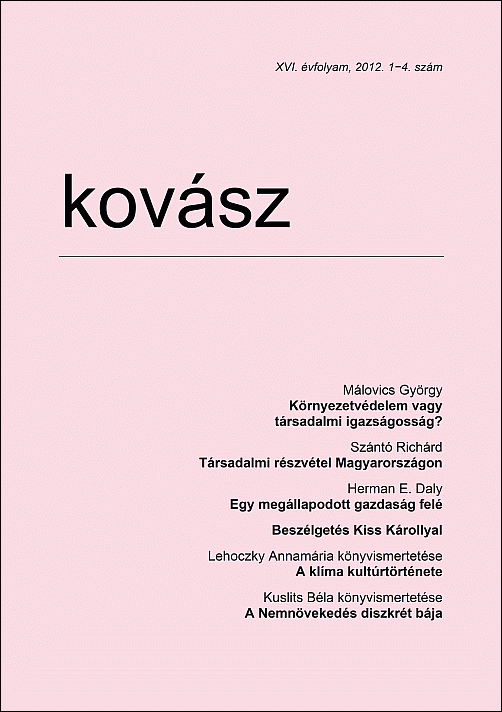
Környezetvédelem vagy társadalmi igazságosság? - A környezeti igazságosság koncepciójának értelmezési lehetőségei és hazai jelentősége
DOI:
https://doi.org/10.14267/kov.2012e1Kulcsszavak:
igazságosság, környezetvédelem, zöldekAbsztrakt
A környezeti igazságosság koncepciója az utóbbi két évtizedben egyre inkább a nemzetközi tudományos főáram részének tekinthető. Ennek ellenére hazánkban viszonylag kevés kutató foglalkozik ezzel, s ennek megfelelően félig-meddig ismeretlen a téma a szélesebb tudományos közönség előtt. Mindez annak ellenére igaz, hogy egyes vélemények szerint ez lehet az a gondolkodásmód, amely folyamatosan terjed a globális zöldmozgalom berkein belül, és lassan leváltja - de legalábbis komolyan megváltoztatja - a hagyományosabb zöld nézeteket. Tanulmányom fő célja, hogy hozzájáruljon egy hazai környezeti igazságossági diskurzus elindításához.
Hivatkozások
Adeola, F. (2000): Cross-National Environmental Injustice and Hu-man Right Issues. A review of Evidence in the Developing World; American Behavioral Scientist 43 (4), 686–706.
Anderton, D. L. – Anderson, A. B. – Oakes, J. M. – Fraser, M. R. (1994): Environmental Equity: The Demographics of Dumping. De-mography, 31, 2, 229-248.
Bajmócy Z. (2009): Bevezetés a helyi gazdaságfejlesztésbe; SZTE GTK, Szeged
Barry, J. M. (2008): „A Small Group of Thoughtful, Committed Citi-zens”: Women’s Activism, Environmental Justice, and the Coal River Mountain Watch; Environmental Justice 1, 25–33.
Boda Zs. – Scheiring G. (2006): Zöld közpolitika-befolyásolás az Eu-rópai Unióban; Politikatudományi Szemle 15 (4), 41–74.
Bodorkós, B. (2010): Társadalmi részvétel a fenntartható vidékfej-lesztésben: a részvételi akciókutatás lehetőségei. Doktori értekezés. Szent István Egyetem, Környezettudományi Doktori Iskola, Gödöllő.
Bodorkós B. – Mertens, C. (2009): Kié a föld? – Intézményi elemzés a természetvédelem helyi irányításáról. Természetvédelmi Közlemé-nyek, 15, 103-118.
Bowen, W. (2002): An Analytical Review of Environmental Justice Research: What Do We Really Know?; Environmental Management 29 (1), 3–15.
Brulle, R. J – Pellow, D. N. (2006): Environmental Justice: Human Health and Environmental Inequalities; Annual Review of Public Health 27; 3.1–3.22.
Bullard, R. D. (é. n.): Environmenmtal Justice in the 21st Century; http://www.ejrc.cau.edu/ejinthe21century.htm (2011. 09. 24-i állapot szerint)
Carruthers, D. V. (szerk.) (2009): Environmental Justice in Latin America: Problems, Promise, and Practice; MIT Press, London
Castells, M. (2006): Az én kizöldülése: A környezeti mozgalom; in. Az információ kora: Gazdaság, társadalom, kultúra; II. kötet (Az identitás hatalma), Gondolat, Budapest, 213–240.
Egan, M. (2002): Subaltern Environmentalism in the United States: A Historiographic Review; Environment and History 8, 21–41.
Funtowicz, S. – Ravetz, J. (2003): Post-Normal Science; Internet Encyclopaedia of Ecological Economics, http://www.ecoeco.org/pdf/ pstnormsc.pdf (2011. 09. 24-i állapot szerint)
Gottlieb, R. (2009): Where We Live, Work, Play... and Eat: Expan-ding the Environmental Justice Agenda; Environmental Justice 2 (1), 7–8.
Guha, R. (1989): Radical American Environmentalism: A Third World Critique; Environmental Ethics 11 (1), 71–83.
Harner, J. – Warner, K. – Pierce, J. – Huber, T. (2002): Urban Envi-ronmental Justice Indices; The Professional Geographer 54 (3), 318–331.
Harper, K. – Steger, T. – Filcak, R. (2009): Environmental Justice and Roma Communities in Central and Eastern Europe; Environ-mental Policy and Governance 19 (4), 251–268.
Józsa Z. (2006): Önkormányzati szervezet, funkció, modernizáció; Dialóg Campus, Budapest–Pécs
Kelemen E. (2011): Árak vagy érvek? Módszertani dilemmák a ter-mészet szolgáltatásainak értékelésében. Kovász, tavasz–tél, 33–59.
Kelemen E. – Málovics Gy. – Margóczi K. (2009): Ökoszisztéma szolgáltatások felmérése során feltárt konfliktusok az Alpári-öblö-zetben; Természetvédelmi Közlemények 15, 119–133. http://www. mbtktv.mtesz.hu/tvk/2009/11_kelemeneszter_119-133.pdf (2011. 09. 24-i állapot szerint.)
Low, N. – Gleeson, B. (2009): Környezeti igazságosság: A környe-zeti minőség elosztása; in. Scheiring G. – Jávor B. (2009), 408–449.
Maantay, J. – Maroko, A. (2009): Mapping urban risk: Flood ha-zards, race, & environmental justice in New York; Applied Geo-graphy 29 (1), 111–124.
Martínez-Alier, J. (2000): Environmental Justice, Sustainability and Valuation; Harvard Seminar on Environmental Values, http:// ecoethics.net/hsev/200003txt.htm (2011. 09. 24-i állapot szerint.)
Martínez-Alier, J. (2001): Mining conflicts, environmental justice, and valuation; Journal of Hazardous Materials 86, 153–170.
Martínez-Alier, J. (2002): The Environmentalism of the Poor. A Report for UNRISD for the WSSD http://www.wrm.org.uy/actors/ WSSD/alier.pdf (2011. 09. 24-i állapot szerint.)
Martínez-Alier, J. (2009): Irányzatok a környezeti mozgalomban; in. Scheiring G. – Jávor B. (2009), 27–46.
Oliver, P. E. – Cadena-Roa, J. – Strawn, K. D. (2002): Emerging Trends in the Study of Protest and Social Movements; in. Dobratz, B. A. – Buzzell, T. – Waldner, L. K. (szerk.): Theoretical Directions in Political Sociology for the 21st Century; JAI Press, http://www.ssc. wisc.edu/~oliver/PROTESTS/ArticleCopies/EmergingSMAug02Final SP1.pdf (2011. 09. 24-i állapot szerint.)
Paavola, J. (2005): Seeking Justice: International Environmental Governance and Climate Change; Globalizations 2 (3), 309–322.
Pataki Gy. (2008): Érdekkonfliktusok a természetvédelemben (Inte-rest-based conflicts in nature conservation); 5th Hungarian Con-ference of Biological Conservation, Nyíregyháza
Pedersen, O. W. (2009): Transatlantic Movements of Justice: A Sto-ry of Inspiration and Diversity; Environmental Justice 2 (1), 35–41.
Ravetz, J. (2004): The post-normal science of precaution. Futures, 36, 347–357
Rechnitzer J. (szerk.) (2007): Település és fejlesztés. A közszolgá-ltatások hatékonyságának növelése a településfejlesztésben; KSzK ROP 3.1.1. Programigazgatóság, Budapest
Sachs, W. (2008): Ökológia és emberi jogok; Kovász 12 (3–4), 15–56.
Scheiring G. (2008): Seattle nyomában. A globalizációkritikai moz-galom mint a globális kormányzás új tényezője; Politikatudományi Szemle 3, 87–107.
Scheiring G. – Jávor B. (szerk.) (2009): Oikosz és Polisz – Zöld poli-tikai filozófiai szöveggyűjtemény; L'Harmattan, Budapest
Schweizer, E. (1999): Environmental Justice: An Interview with Ro-bert Bullard; Earth First! Journal; http://www.ejnet.org/ej/bullard.html
Sellers, C. (2008): Environmental Justice as a Way of Seeing; Envi-ronmental Justice 1 (4), 177–178.
Steger, T. (2007): Making the Case for Environmental Justice in Central and Eastern Europe; CEPL-HEAL-The Coalition for Environ-mental Justice, Budapest, http://www.envhealth.org/IMG/pdf/ Making_the_case_for_environmental_justice.pdf (2011. 09. 24-i álla-pot szerint)
Steger, T. – Filcak, R. (2008): Articulating the Basis for Promoting Environmental Justice in Central and Eastern Europe; Environmen-tal Justice 1, 49–53.
Szabó M. (szerk.) (1999): Környezetvédelmi civil kezdeményezések Magyarországon (1988–1998). Tanulmányok; Villányi úti Konferen-ciaközpont és Szabadegyetem Alapítvány, Budapest
Szabó M. (2001): Társadalmi mozgalmak és politikai tiltakozás – tör-téneti és összehasonlító perspektívában; Rejtjel Kiadó, Budapest
Sze, J. – London, J. K. (2008): Environmental Justice at the Cross-roads; Sociology Compass 2 (4),1331–1354.
Taylor, D. A. (2000): The Rise of the Environmental Justice Para-digm: Injustice Framing and the Social Constriction of Environmental Discourses; American Behavioral Scientist 43, 508–580.
UCC (1987): Toxic Wastes and Race in The United States; UCC Commision for Racial Justice, New York, http://www.ucc.org/about-us/archives/pdfs/toxwrace87.pdf (2011. 09. 24-i állapot szerint.)
UCC (2007): Toxic Wastes and Race at Twenty: 1987–2007. Grassroots Struggles to Dismantle Environmental Racism in the United States; A Report Prepared for the United Church of Christ Justice and Witness Ministries, http://www.ucc.org/assets/pdfs/ toxic20.pdf (2011. 09. 24-i állapot szerint.)
USGAO (1983): Siting of Hazardous Waste Landfills and Their Cor-relation With Racial and Economic Status of Surrounding Commu-nities; General Accounting Office, GAO/RCED-83-168. Washington, DC, http://archive.gao.gov/d48t13/121648.pdf (2011. 09. 24-i állapot szerint.)
Washington, S. H. (2008): Mrs. Block Beautiful: African American Women and the Birth of the Urban Conservation Movement, Chi-cago, Illinois, 1917–1954; Environmental Justice 1, 13–23.
Letöltések
Megjelent
Folyóirat szám
Rovat
License
Copyright (c) 2012 Kovász

This work is licensed under a Creative Commons Attribution 4.0 International License.