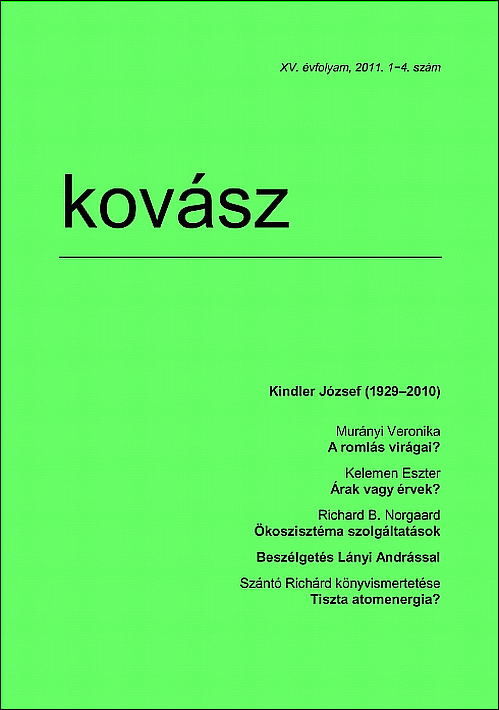
Richard B. Norgaard: Ökoszisztéma szolgáltatások - Hogyan vált egy szemléletes metafora a lényeg elhomályosítójává?
DOI:
https://doi.org/10.14267/kov.2011e3Kulcsszavak:
értékelés, jövő nemzedékek, intézményekAbsztrakt
Bár az ökoszisztéma szolgáltatások fogalma eredetileg azt a célt szolgálta, hogy fölhívja az emberek figyelmét a természet fontosságára és rávilágítson a fokozódó anyag- és energiafelhasználás által előidézett ökológiai problémákra, tizenöt év alatt olyan modellé vált, amely mára meghatározó szerepet tölt be a fejlődő országok, sőt az egész világ főáramú környezetpolitikájában és környezeti menedzsmentjében. Az ökoszisztéma szolgáltatásokat érintő kérdésekben professzionális szakemberek egész hada ad tanácsot. Azok a szálak azonban, amelyek a folyamatos gazdasági növekedés által fölvetett problémákhoz kötötték az eredeti metaforát, igencsak meggyengültek. A széndioxid-egyenérték bevezetésével, valamint azzal, hogy a szegény országok megpróbálják optimalizálni az ökoszisztéma szolgáltatások használatát, a gazdag országok fönntarthatják azt az illúziójukat, hogy fogyaszthatnak tovább a jól megszokott szinten.
Hivatkozások
Adger, W. N. – Jordan, A. (2009): Governing Sustainability; Cam-bridge University Press, Cambridge, UK
Armsworth, P. R. et al. (2007): Ecosystem-service science and the way forward for conservation; Conservation Biology 21 (6), 1383–1384.
Baer, P. – Athanasiou, T. – Kartha, S. – Kemp-Benedict, E. (2008): The greenhouse development rights framework: the right to develop-ment in a climate constrained world; Revised second edition, Heinrich Böll Foundation, Christian Aid, EcoEquity and the Stockholm Environment Institute, Berlin
Baer, P. – Mastrandrea, M. (2006): High Stakes: Designing Emis-sions Pathways to Reduce the Risk of Dangerous Climate Change; Institute for Policy Research, London
Barnosky, A. D. (2009): Heatstroke: Nature in an Age of Global War-ming; Island Press, Washington, D. C.
Biggs, R. – Carpenter, S. R. – Brock, W. (2009): Spurious certainty: how ignoring measurement error and environmental heterogeneity may contribute to environmental controversies; BioScience 59 (1), 65–76.
Bromley, D. W. (1989): Entitlements, missing markets, and environ-mental uncertainty; Journal of Environmental Economics and Mana-gement 17 (2), 181–194.
Bromley, D. W. (2007): Environmental regulations and the problem of sustainability: moving beyond market failure; Ecological Econo-mics 63 (4), 676–683.
Carpenter, S. R. et al. (2006): Millennium ecosystem assessment: research needs; Science 314, október 13., 257–258.
Coase, R. H. (1937): The nature of the firm; Economica 4, 386–405.; magyarul lásd A vállalat, a piac és a jog című válogatásban, Tan-könyvkiadó, Budapest, 2004
Coase, R. H. (1960): The problem of social cost; Journal of Law and Economics 3 (1), 1–44.; magyarul lásd A vállalat, a piac és a jog című válogatásban, Tankönyvkiadó, Budapest, 2004
Corbera, E. – Kosoy, N. – Martinez-Tuna, M. (2007): The equity implications of marketing ecosystem services in protected areas and rural communities: case studies from meso-America; Global Envi-ronmental Change 17, 365–380.
Costanza, R. – Daly, H. E. (1992): Natural capital and sustainable development; Conservation Biology 6, 37–46.
Cournot, A. (1838/1963): The Mathematical Principles of the Theory of Wealth; Irwin Paperback Classics in Economics, Homewood, Illinois
Daily, G. C. (szerk.) (1997): Nature's Services: Societal Dependence on Natural Systems; Island Press, Washington, D. C.
Daily, G. C. et al. (2000): The value of nature and nature of value; Science 289 (5478), 395–396.
Daly, H. E. (szerk.) (1973): Toward a Steady-State Economy; W. H. Freeman, San Francisco
Daly, H. E. – Farley, J. (2004): Ecological Economics: Principles and Practice; Island Press, Washington, D.C.
Dryzek, J. S. (1987): Rational Ecology: Environment and Political Economy; Basil Blackwell, Oxford
Farrell, K. – van den Hove, S. – Luzzati, T. (szerk.) (2009): Beyond Reductionism: A Passion for Interdisciplinarity; Routledge, London
Fisher, B. – Turner, R. K. – Morling, P. (2009): Defining and classi-fying ecosystem services for decision making; Ecological Economics 68, 643–653.
Folke, C. – Hahn, T. – Olsson, P. – Norberg, J. (2005): Adaptive go-vernance of socio-ecological systems; Annual Review of Environ-ment and Resources 30, 441–473.
Georgescu-Roegen, N. (1971): The Entropy Law and the Economic Process; Harvard University Press, Cambridge, U.S.; magyarul: Az entrópia törvénye és a gazdasági probléma; in. Pataki Gy. – Takács-Sánta A. (szerk.): Természet és gazdaság – Ökológiai közgazda-ságtan szöveggyűjtemény; Typotex, Budapest, 2004, 41–54.
Grieg-Gran, M. – Porras, I. – Wunder, S. (2005): How can market mechanisms for forest environmental services help the poor? Preliminary lessons from Latin America; World Development 33 (9), 1511–1527.
Haddad, B. M. (2000): Rivers of Gold: Designing Markets to Allocate Water in California; Island Press, Washington, D.C.
Hanemann, W. M. – Dyckman, C. (2009): The San Francisco Bay–Delta: a failure of decision-making capacity; Environmental Science and Policy 12 (6), 710–725.
Hansen, J., et al. (2008): Target Atmospheric CO2: Where Should Society Aim?; http://arxiv.org/ftp/arxiv/papers/0804/0804.1126.pdf (2011.06.27-i állapot szerint.)
Harberger, A. (1971): Three postulates for applied welfare econo-mics; Journal of Economic Literature IX (3), 785–797.
Healey, M. – Dettinger, M. – Norgaard, R. B. (szerk.) (2008): The State of Bay–Delta Science, 2008; CALFED science program, Sac-ramento, California
Hirt, P. W. (1994): A Conspiracy of Optimism: Management of the National Forests Since World War Two; University of Nebraska Press, Lincoln
Howarth, R. B. – Norgaard, R. B. (1992): Environmental valuation under sustainable development; American Economic Review 82 (2), 473–477.
Intergovernmental Panel on Climate Change (2007): Climate Chan-ge 2007; három kötet, Cambridge University Press, Cambridge, UK (a döntéshozói összefoglalók magyarul is olvashatók: http://www. met.hu/eghajlat/klimavaltozas/ipcc/ipcc_eghajlatvaltozas_2007.pdf – 2011.06.29-i állapot szerint.)
Jansson, A. M. – Hammer, M. – Folke, C. – Costanza, R. (szerk.) (1994): Investing in Natural Capital: The Ecological Economics App-roach to Sustainability; Island Press, Washington, D.C.
Kosoy, N. – Corbera, E. (2010): Payments for ecosystem services as Commodity fetishism; Ecological Economics 69 (6), 1228–1236.
Jäger, J. (2009): The governance of science for sustainability; in. Adger, W. N. – Jordan, A. (szerk.): Governing Sustainability; Cam-bridge University Press, Cambridge, UK
Jasanoff, S. (1990): The Fifth Branch: Science Advisors as Policy-Makers; Harvard University Press, Cambridge, MA
Lant, C. L. – Ruhl, J. B. – Kraft, S. E. (2008): The tragedy of eco-system services; BioScience 58 (10), 969–974.
Martinez-Alier, J. – Schlupman, K. (1987): Ecological Economics: Energy, Environment and Society; Blackwell, Oxford
Mastrandrea, M. D. – Schneider, S. H. (2004): Probabilistic assess-ment of “dangerous” climate change; Science 304 (5670), 571–575.
McAfee, K. (1999): Selling nature to save it? Biodiversity and green developmentalism; Environment and Planning D – Society and Spa-ce 17 (2), 133–154.
Meyer, L. H. – Roser, D. (2006): Distributive justice and climate change: the allocation of emission rights; Analyse and Kritik 28, 223–249.
Millennium Ecosystem Assessment (2003): Ecosystems and Human Well-Being: A Framework for Assessment; Island Press, Washing-ton, D.C.
Millennium Ecosystem Assessment (2005): Ecosystems and Human Well-Being: Synthesis; Island Press, Washington, D.C.
Muradian, R. – Corbera, E. – Pascual, U. – Kosoy, N. – May, P. H. (2010): Reconciling theory and practice: an alternative conceptual framework for understanding payments for ecosystem services; Ecological Economics 69 (6), 1202–1208.
National Research Council (2007): Understanding multiple environ-mental stresses; Report of a Workshop held by the Committee on Earth–Atmosphere Interactions, Board on Atmospheric Sciences and Climate; National Academies Press, Washington, D.C.
Nordhaus, W. D. (2008): A Question of Balance: Weighing the Op-tions on Global Warming Policies; Yale University Press, New Ha-ven, Connecticut
Norgaard, R. B. (1989): The case for methodological pluralism; Eco-logical Economics 1, 37–57.
Norgaard, R. B. (1994): Development Betrayed: The End of Prog-ress and a Coevolutionary Revisioning of the Future; Routledge, London
Norgaard, R. B. (2008a): Finding hope in the Millennium Ecosystem Assessment; Conservation Biology 22, 862–869.
Norgaard, R. B. (2008b): The implications of interdisciplinary scien-tific assessments for environmental governance; in. Ranganathan, J. – Munasinghe, M. – Irwin, F. (szerk.): Policies for Sustainable Go-vernance of Global Ecosystem Services; 8. fejezet, Edward Elgar, Cheltenham, U.K.
Norgaard, R. B. – Baer, P. (2005a): Collectively seeing complex sys-tems: the nature of the problem; BioScience 55, 953–960.
Norgaard, R. B. – Baer, P. (2005b): Collectively seeing complex sys-tems: the limits of formal models; BioScience 55, 961–966.
Norgaard, R. B. – Kallis, G. – Iparsky, M. (2009): Collectively enga-ging complex socioecological systems: reinvisioning science, gover-nance, and the California delta; Environmental Science and Policy 12 (6), 644–652.
Nowotny, H. – Scott, P. – Gibbons, M. (2001): Re-thinking Science: Knowledge and the Public in an Age of Uncertainty; Polity, Cam-bridge, UK.
Ostrom, E. (1990): Governing the Commons: The Evolution of Insti-tutions for Collective Action; Cambridge University Press, Cam-bridge, UK
Pagiola, S. et al. (2004): Paying for biodiversity conservation servi-ces in agricultural landscapes; Environment Department Paper, vol. 96. The World Bank, Washington, D.C.
Pagiola, S. – Arcenas, A. – Platias, G. (2005): Can environmental services help reduce poverty? An exploration of the issues and the evidence to date from Latin America; World Development 33 (2), 237–253.
Palmer, M. A. – Filoso, S. (2009): Restoration of ecosystem services for environmental markets; Science 325, július 31., 575–576.
Pascual, U. et al. (2010): Exploring the links between equity and efficiency in payments for environmental services: A conceptual approach; Ecological Economics 69 (6), 1237–1244.
Polanyi, K. (1944): The Great Transformation: The Political and Eco-nomic Origins of Our Time; Rhinehart, New York; magyarul: A nagy átalakulás – Korunk gazdasági és politikai gyökerei; Napvilág Kiadó, Budapest, 2005
Prugh, T. – Costanza, R. et al. (1999): Natural Capital and Human Economic Survival; Lewis Publishers, Boca Raton, Florida
Ranganathan, J. et al. (2008): Ecosystem Services: A Guide for De-cision Makers; World Resources Institute, Washington, D.C.
Sachs, W. – Santarius, T. (szerk.) (2005): Fair Future: Resource Conflicts, Security, and Global Justice; Zed Books, London
Shapiro, E. N. – McAfee, K. (2008): To empty the countryside of far-mers? Contesting the neoliberal nature of payment for ecosystem services in Mexico; Paper Presented at the Association of American Geographers Annual Meetings, 2008. április 18., Boston, MA
Söderbaum, P. (2000): Ecological Economics: A Political Economics Approach to Environment and Development; Earthscan, London
Srinivasan, U. T. et al. (2008): The debt of nations and the distri-bution of ecological impacts from human activities; Proceedings of the National Academy of Sciences 105 (5), 1768–1773.
Stern, N. (2007): The Economics of Climate Change: The Stern Re-view; Cambridge University Press, Cambridge, UK
UNEP (2008): Payments for Ecosystem Services: Getting Started. A Primer; UNEP, Nairobi
UNFAO, UNDP and UNEP (2008): Framework document; UN Colla-borative Programme on Reducing Emissions from Deforestation and Forest Degradation in Developing Countries (UN-REDD), Rome
United Nations (2008): UN Collaborative Programme on Reducing Emissions from Deforestation and Forest Degradation in Developing Countries UN–REDD; FAO, UNDP, UNEP Framework Document 20, 2008. június
Walker, B. H. – Meyers, J. A. (2003): Thresholds in ecological and social-ecological systems: a developing database; Ecology and Society 9; http://www.ecologyandsociety.org/vol9/iss2/art3/ (2011. 06.27-i állapot szerint.)
Vanderheiden, S. (2008): Atmospheric Justice: A Political Theory of Climate Change; Oxford University Press, Oxford
Vatn, A. (2005): Institutions and the Environment; Edward Elgar, Cheltenham, UK
Vatn, A. (2009): An institutional analysis of methods for environ-mental appraisal; Ecological Economics 68 (8–9), 2207–2215.
Vatn, A. (2010): An institutional analysis of payments for environ-mental services; Ecological Economics 69 (6), 1245–1252.
Williamson, O. (1996): The Mechanisms of Governance; Oxford Uni-versity Press, Oxford
Wilson, J. – Low, B. – Costanza, R. – Ostrom, E. (1999): Scale mis-perceptions and the spatial dynamics of socio-ecological systems; Ecological Economics 31 (2), 243–257.
Wilson, M. A. – Howarth, R. B. (2002): Discourse-based valuation of ecosystem services: establishing fair outcomes through group deli-beration; Ecological Economics 41 (3), 431–443.
World Bank (2009): Environment Matters at the World Bank: Valuing Coastal and Marine Ecosystem Services; World Bank, Washington, D.C.
Zellmer, A. J. – Allen, T. F. H. – Kesseboehmer, K. (2006): The na-ture of ecological complexity: a protocol for building the narrative; Ecological Complexity 3, 171–182.
Letöltések
Megjelent
Folyóirat szám
Rovat
License
Copyright (c) 2011 Kovász

This work is licensed under a Creative Commons Attribution 4.0 International License.