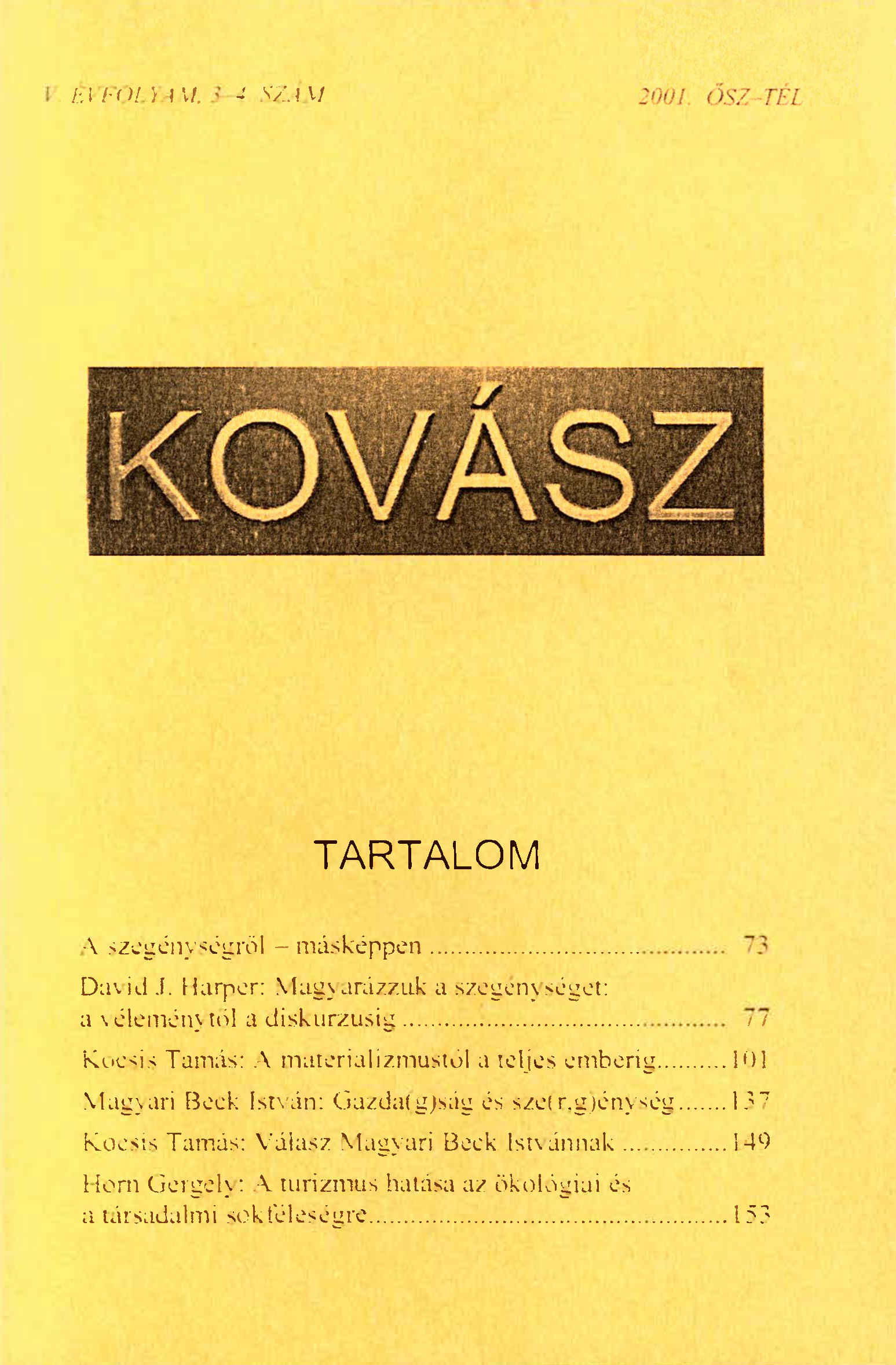
A materializmustól a teljes emberig - A fogyasztás önkéntes csökkentéséről a nyugati társadalmakban
DOI:
https://doi.org/10.14267/kov.20013e2Kulcsszavak:
boldogság, életminőség, empíria, etika, fejlődés, fenntarthatóság, fogyasztás, gazdagság, gazdaság, jólét, konzumerizmus, környezet (természeti), marketing, materializmus, média, mérés, növekedés, pszichológia, szegénység, szinkretizmus, túlfogyasztás, vallásAbsztrakt
Modernizáció, csatlakozás, felzárkózás, lépéstartás, nyugati életszínvonal és társaik kulcsszavak napjaink uralkodó diskurzusában. Az átlagember és a politikus egyértelműen azt tekinti fejlődésnek, ami a nyugati társadalmi-gazdasági modell sikeres átvétele felé mutat. Az abszolút szegénység, vagyis az emberi alapszükségleteket sem kielégítő állapot elleni küzdelem erkölcsi szempontból megkérdőjelezhetetlen, ám a Townsend munkássága óta felismert viszonylagos, azaz pusztán a mások jólétéhez képest értelmezhető relatív szegénység vizsgálata a mainál sokkal alaposabb körültekintést kíván. A világ leggazdagabbjainak életmódja ma már egyre szélesebb körben válik ismertté, s ezzel párhuzamosan egyre többen érzik magukat jobb sorsra érdemes szegénynek; egyre több emberre tekintünk úgy, mint segítségre szoruló szegényre; s egyre inkább e tömegek anyagi életszínvonalának emelésére hivatkoznak a politikai erőfeszítések, miközben más fontos szempontok a háttérbe szorulnak. Az anyagi életszínvonal emelése elfogadható célkitűzés lehet, ám alapos vizsgálat tárgyává kell tenni a folyamat esetleges árnyoldalait is, s az anyagiakban leginkább dúskáló társadalmak működéséből levonni a számunkra is használható tanulságokat. Csakugyan emberhez méltatlan élet-e az, ha légkondicionáló berendezés híján el kell viselnünk a 30 Celsius-fokos kánikulát, vagy ha tízpercnyi autózással sem érthetünk el egy kiváló minőségű autópályát? Ráadásul a kérdés ma már egyre kevésbé úgy merül fel, hogy milyen hazai gazdaságpolitikával közelíthetjük meg a fejlettnek tartott nyugati világ anyagi életszínvonalát, hanem inkább úgy, hogy milyen mértékben célszerű belesimulnunk egy világméretűvé váló fogyasztói társadalomba.
Hivatkozások
Andrews, C. [1997]: The Circle of Simplicity: Return to the Good Life; HarperCollins, New York
Andrews, F. M. - Withey, S. B. [1976]: Social Indicators of Well-Being: Americans' Perceptions of Life Quality; Plenum, New York
Belk, R. W. - Pollay, R. W. [1985]: Images of Ourselves: The Good Life in Twentieth Century Advertising; Journal of Consumer Research 11, március, 887-897. o.
Belk, R. W. [1984]: Three Scales to Measure Constructs Related to Materialism: Reliability, Validity, and Relationships to Measures of Happiness; Advances in Consumer Research, Vol. 11., Association for Consumer Research, Provo, UT, 291-297. o.
Belk, R. W. [1985]: Materialism: Trait Aspects of Living in the Material World; Journal of Consumer Research, Vol. 12., december, 265-280. o.
Blix, J. - Heitmiller, D. [1999]: Getting a Life: Real Lives Transformed by Your Money or Your Life; Penguin Books, New York, NY
Brickman, P. - Campbell, D. T. [1971]: Hedonic Relativism and Planning the Good Society; in. Appley, H. D. (szerk.): Adaptation-Level Theory: A Symposium; Academic Press, New York, 287-302. o.
Csányi V. [1999]: Az emberi természet: Humánetológia; Tudomány-Egyetem sorozat, Vince Kiadó, Budapest
Diener, E. - Horwitz, J. - Emmons, R. A. [1985]: Happiness of the very wealthy; Social Indicators Research 16, 263-274. o.
Diener, E. [1984]: Subjective Well-Being; Psychological Bulletin, Vol. 95. No. 3., 542-575. o.
Dominguez, J. - Robin, V. [1999]: Your Money or Your Life: Transforming Your Relationship with Money and Achieving Financial Independence; frissített segédletlistával bővített kiadás, Penguin Books, New York, NY
Easterlin, R. A. [1995]: Will raising the incomes of all increase the happiness of all?; Journal of Economic Behavior and Organization, Vol. 27., 35-47. o.
Elgin, D. - Mitchell, A. [1977]: Voluntary Simplicity (3); The CoEvolution Quarterly, nyár, 4-19. o.
Elgin, D. [1993]: Voluntary Simplicity: Toward a Way of Life That Is Outwardly Simple, Inwardly Rich; Revised Edition, Morrow, New York
Ellis, S. R. [1992]: A Factor Analytic Investigation of Belk's Structure of the Materialism Construct; Advances in Consumer Research, Vol. 19., 688-695. o.
Etzioni, A. [1998]: Reply to Peter Taylor-Gooby; Journal of Economic Psychology 19, 651-652. o.
Faber, R. J. - O'Guinn, T. C. [1992]: A Clinical Screener for Compulsive Buying; Journal of Consumer Research 19, 459-469. o.
Flouri, E. [1999]: An integrated model of consumer materialism: Can economic socialization and maternal values predict materialistic attitudes in adolescents?; Journal of Socio-Economics 28, 707-724. o.
French, J. R. P. Jr. - Rodgers, W. - Cobb, S. [1974]: Adjustment as Person-Environment Fit; in. Coelho, G. V. - Hamburg, D. A. - Adams, J. E. (szerk.): Coping and Adaptation; Basic Books, New York
Goodwin, N. R. [1997]: Visions of an Alternative: Overview Essay; in. Goodwin, N. R. - Ackerman, F. - Kiron, D. (szerk.): The Consumer Society; Island Press, Washington, DC; Covelo, California, 333-343. o.
Graham, E. [1996]: How to Sell More to Those Who Think It's Cool to be Frugal; Wall Street Journal, szeptember 30., keleti kiadás, B1-B2. o.
Gregg, R. [1936]: Voluntary Simplicity; Visva-Bharati Quarterly, augusztus, újranyomva in. The CoEvolution Quarterly, 1977, nyár, 20-27. o.
Hirsch, F. [1976]: Social Limits to Growth; Harvard University Press, Cambridge
Inglehart, R. [1990]: Culture shift in advanced industrial society; Princeton University Press, Princeton, NJ
Kavanaugh, J. F. [1991]: Following Christ in a Consumer Society: The Spirituality of Cultural Resistance; 2. kiadás, Orbis Books, Maryknoll, New York
Kocsis T. [1998]: A Földi Paradicsom prófétái, avagy mérlegen a bizniszkereszténység ideológiája; Kovász, nyár, 58-83. o.
Kopp M. - Skrabski Á. - Szedmák S. [1998]: A bizalom, a társas támogatás, az összetartozás, együttműködés képességének egészségügyi jelentősége; Végeken, 9. évf., 4. szám, 4-11. o.
Lears, J. T. J. [1981]: No Place of Grace: Antimodernism and the Transformation of American Culture, 1880-1920; Pantheon Books, New York
Marcuse, H. [1964]: One Dimensional Man: Studies in the Ideology of Advanced Industrial Society; Beacon Press, Boston
Mason, R. S. [1981]: Conspicuous Consumption: A Study of Exceptional Consumer Behavior; Gower, Westmead, England
McCormick, P. [1997]: Warning: simplicity may complicate your life; U.S. Catholic, július, 46-49. o.
McKendrick, N. - Brewer, J. - Plumb, J. H. [1982]: The Birth of a Consumer Society: The Commercialization of Eighteenth Century England; Europa Publications Limited, London
Mick, D. G. [1996]: Are Studies of Dark Side Variables Confounded by Socially Desirable Responding? The Case of Materialism; Journal of Consumer Research 23, 106-119. o.
Mishan, E. J. [1993]: The Costs of Economic Growth; revised edition, Weidenfeld and Nicolson, London (első megjelenés: 1967)
Moschis, G. P. - Moore, R. L. [1982]: A Longitudinal Study of Television Advertising Effects; Journal of Consumer Research 9, 279-286. o.
Mukerji, C. [1983]: From Graven Images: Patterns of Modern Materialism; Columbia University Press, New York
Muncy, J. A. - Eastman, J. K. [1998]: Materialism and Consumer Ethics: An Exploratory Study; Journal of Business Ethics 17, 137-148. o.
Myers, D. G. - Diener, E. [1995]: Who Is Happy?; Psychological Science, Vol. 6., No. 1., január, 10-19. o.
Nash, J. A. [2000]: A mértékletesség felforgató erényének felelevenítése és megújítása felé; Kovász, tavasz-tél, 25-52. o.
New Road Map Foundation [1996]: Your Money or Your Life: A Group Study Guide for Contemporary Christians, to be used with the book Your Money or Your Life by Joe Dominguez and Vicki Robin; New Road Map Foundation, Seattle, WA
Polányi K. [1997]: A nagy átalakulás - Korunk gazdasági és politikai gyökerei; Mészáros Gábor kiadása, h. n. (eredeti megjelenés: 1946)
Princen, T. [1999]: Consumption and environment: some conceptual issues; Ecological Economics 31, 347-363. o.
Ray, P. H. [1997]: The Emerging Culture; American Demographics, február, 29-34., 56. o.
Richins, M. L. - Dawson, S. [1992]: A Consumer Values Orientation for Materialism and its Measurement: Scale Development and Validation; Journal of Consumer Research, Vol. 19., december, 303-316. o.
Richins, M. L. - Rudmin, F. W. [1994]: Materialism and economic psychology; Journal of Economic Psychology 15, 217-231. o.
Richins, M. L. [1987]: Media, Materialism, and Human Happiness; Advances in Consumer Research, Vol. 14. Association for Consumer Research, Provo, UT, 352-356. o.
Richins, M. L. [1999]: Material Values; in. Earl, P. E. - Kemp, S. (szerk.): The Elgar Companion to Consumer Research and Economic Psychology; Edward Elgar, Cheltenham, UK, Northampton, MA, USA, 374-380. o.
Rindfleish, A. - Burroughs, J. E. - Denton, F. [1997]: Family Structure, Materialism, and Compulsive Consumption; Journal of Consumer Research 23, 312-325. o.
Rudmin, F. W. - Kilbourne, W. E. [1995]: The Meaning and Morality of Voluntary Simplicity: History and Hypotheses on Deliberately Denied Materialism; in. Belk, R. W. - Dholakia, N. - Venkatesh, A. (szerk.): Consumption and marketing, macro dimensions; South-Western College Publishing, Cincinnati, Ohio, 166-215. o.
Schor, J. [1999]: What's Wrong with Consumer Society? Competitive Spending and the "New Consumerism"; in. Rosenblatt, R. (szerk.): Consuming Desires: consumption, culture, and the pursuit of happiness; Island Press, Washington, DC
Schumacher, E. F. [1991]: A kicsi szép - Tanulmányok egy emberközpontú közgazdaságtanról; Közgazdasági és Jogi Könyvkiadó, Budapest
Scitovsky T. [1990]: Az örömtelen gazdaság; Közgazdasági és Jogi Könyvkiadó, Budapest (első külföldi megjelenés: 1976)
Shama, A. [1981]: Coping with stagflation: voluntary simplicity; Journal of Marketing 45, 120-134. o.
Shama, A. [1995]: A Comment on »The Meaning and Morality of Voluntary Simplicity: History and Hypotheses on Deliberately Denied Materialism«; in. Belk, R. W. - Dholakia, N. - Venkatesh, A. (szerk.): Consumption and marketing, macro dimensions; South-Western College Publishing, Cincinnati, Ohio, 216-224. o.
Shi, D. E. [1985]: The Simple Life: Plain Living and High Thinking in American Culture; Oxford University Press, New York, Oxford
Stone, I. F. [1988]: The Trial of Socrates; Little, Brown and Co., Toronto
Szabó A. - Szabó L. [1994]: Az életszínvonalról alkotott vélemények és a jövedelmek összefüggései; Szociológiai Szemle, 3. szám, 93-123. o.
Thoreau, H. D. [1999]: Walden; Fekete Sas Kiadó (első külföldi megjelenés: 1861)
Townsend, P. [1979]: Poverty in the United Kingdom - A survey of Household Resources and Standard of Living; Penguin, Harmondsworth
Toynbee, A. [1947]: A Study of History; 1. kötet, Oxford University Press, New York
Twitchell, J. B. [1999]: Lead Us Into Temptation - The Triumph of American Materialism; Columbia University Press, New York
Urbán R. [1995]: Boldogság, személyiség, egészség; Magyar Pszichológiai Szemle, 5-6. szám, 379-404. o.
Vitell, S. J. - Muncy, J. A. [1992]: Consumer Ethics: An Empirical Investigation of Factors Influencing Ethical Judgements of the Final Consumer; Journal of Business Ethics 11, 585-598. o.
Williams, J. - Bryce, W. [1992]: Materialism and Care for Others; in. Rudmin, F. - Richins, M. (szerk.): Meaning, Measure, and Morality of Materialism; The Association for Consumer Research, Provo, UT, 149-157. o.
Letöltések
Megjelent
Folyóirat szám
Rovat
License
Copyright (c) 2001 Kovász

This work is licensed under a Creative Commons Attribution 4.0 International License.