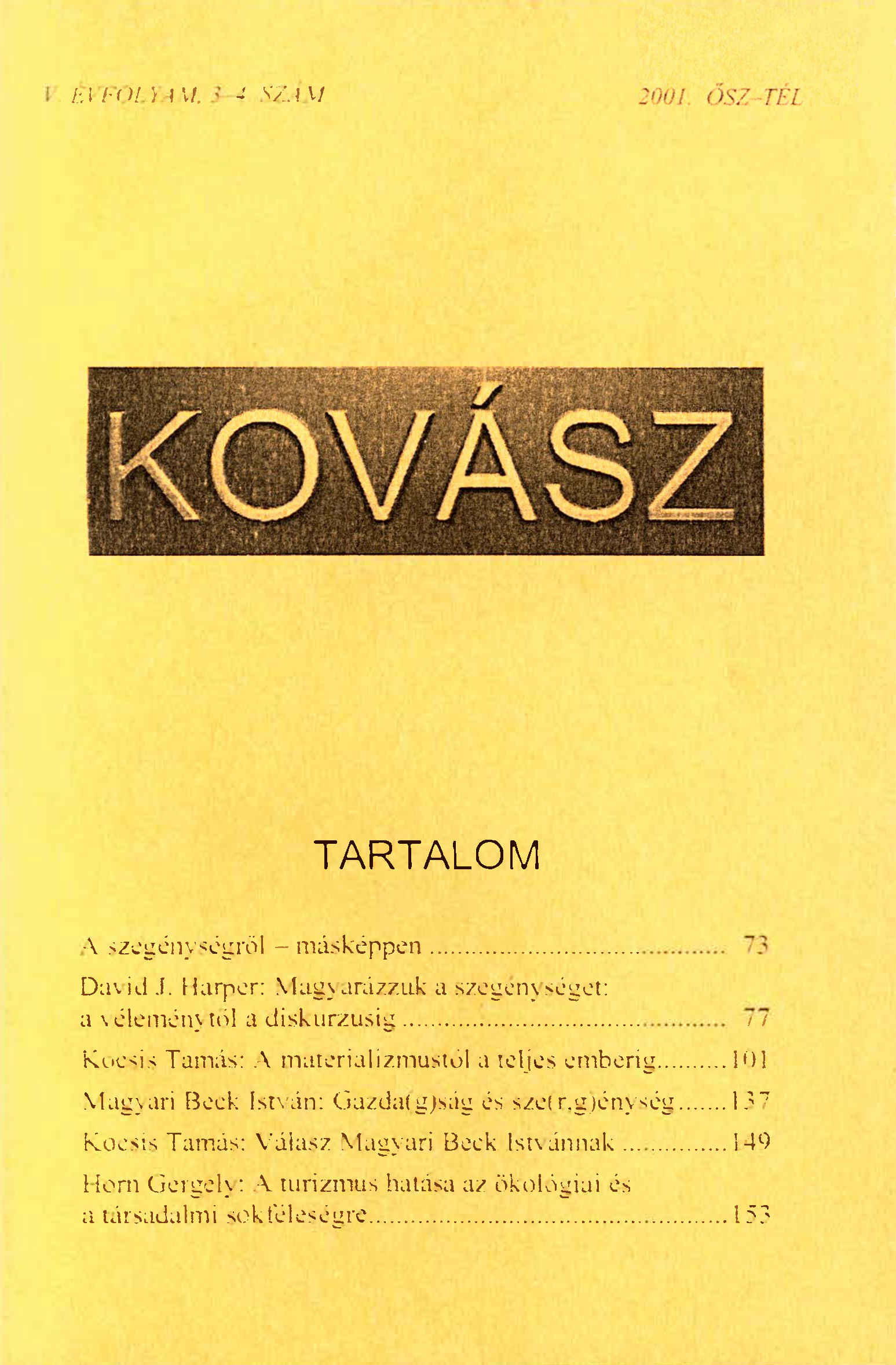
David J. Harper: Magyarázzuk a szegénységet: a véleménytől a diskurzusig
DOI:
https://doi.org/10.14267/kov.20013e1Kulcsszavak:
diskurzus, érdek, kormányzat, kutatás, média, módszertan, pszichológia, segély, szegénység, szervezet, társadalom, vállalatAbsztrakt
Már két évtizede, hogy Feaginnek az amerikai szegénység értelmezéseit kutató klasszikussá vált tanulmánya (1972) szolgál útmutatóul a szegénységre adott magyarázatok vizsgálatában. Ez alatt az idő alatt a szegénység-magyarázatokkal foglalkozó irodalomban az attribuciós paradigma érvényesült, amely az egyének megkérdezésével igyekszik rekonstruálni azt, hogy egy adott társadalomban mit tekintenek a szegénység okának. E tanulmány arra hivatott rámutatni, hogy ez az uralkodó megközelítés egyrészt korlátozza a kutatás során feltehető kérdések körét, másrészt kudarcot vall abban, hogy a szegénység leküzdésére szolgáló társadalmi és politikai cselekvés számára használható magyarázatokkal szolgáljon. Az alábbiakban csak egy rövid áttekintést nyújtunk e megközelítés irodalmáról, mivel e témában már több hasznos összefoglalás jelent meg (Furnham [1988]; Furnham-Lewis [1986]).
Hivatkozások
Adler, T. [1990]: Aid agencies grappling with behavioral issues; APA Monitor, 21(7) (július), 34-35. o.
Billig, M. - Condor, S. - Edwards, D. - Gane, M. - Middleton, D. - Radley, A. R. [1988]: Ideological Dilemmas; Sage, London
Brazier, C. [1992]: Changing charity; New Internationalist, február, 4-7. o.
Brookes, H. J. [1995]: 'Suit, tie and a touch of juju' - the ideological construction of Africa: A critical discourse analysis of news on Africa in the British press; Discourse and Society, 6(4), 461-494. o.
Burman, E. [1991]: What discourse is not; Philosophical Psychology, 4, 325-342. o.
Burman, E. [1994a]: Poor children: charity appeals and ideologies of childhood; Changes, 12, 29-36. o.
Burman, E. [1994b]: Development phallacies: psychology, gender and childhood; Agenda: A Journal about Women and Gender, 22, 11-20. o.
Burman, E. [1994c]: Innocents abroad: Western fantasies of childhood and the iconography of emergencies; Disasters: The Journal of Disaster Studies and Management, 18, 238-253. o.
Burman, E. - Parker, I. [1993]: Discourse Analytic Research: Repertoires and Readings of Texts in Action; Routledge, London
Chambers, R. [1995]: Poverty and livelihoods: whose reality counts; Environment and Urbanization, 7, 173-204. o.
Charnel 4 Television [1991]: Hard times: how the media portrays poverty; The Media Show, március 17.
Christian Aid News [1995]: Third world losing out on TV; Christian Aid News, 87 (április-június), 2. o.
Cohen, R. L. [1982]: Perceiving justice: an attributional perspective; in. R. L. Cohen - J. Greenberg (szerk.): Equity and Justice in Social Behavior; Academic Press, New York
Cohen, R. L. - Greenberg, J. (szerk.) [1982]: Equity and Justice in Social Behavior; Academic Press, New York
Commission of the European Communities [1977]: The Perception of Poverty in Europe; EEC, Brussels
Coles, J. [1991]: Trust tops Oxfam as favourite charity; The Guardian, november 15.
Curt, B. C. [1994]: Textuality and Tectonics: Troubling Social and Psychological Science; Open Universities Press, Buckingham
Derrida, J. [1994]: Spectres of Marx; New Left Review, 205, 31-58. o.
Eayrs, C. B. - Ellis, N. [1990]: Charity advertising: for or against people with a mental handicap?; British Journal of Social Psychology, 29, 349-360. o.
Edelman, M. [1977]: Political Language: Words that Succeed and Policies that Fail; Academic Press, Florida
Edwards, D. - Potter, J. [1992]: Discursive Psychology; Sage, London
Feagin, J. R. [1972]: Poverty: we still believe that God helps those who help themselves; Psychology Today, november, 101-129. o.
Feather, N. T. [1974]: Explanations of poverty in Australian and American samples: the person, society, or fate?; Australian Journal of Psychology, 26(3), 199-216. o.
Furnham, A. [1982]: Why are the poor always with us? Explanations for poverty in Britain; British Journal of Social Psychology, 21, 311-322. o.
Furnham, A. [1988]: Lay Theories: Everyday Understanding of Problems in the Social Sciences; Pergamon, Oxford
Furnham, A. - Gunter, B. [1984]: Just world beliefs and attitudes towards the poor; British Journal of Social Psychology, 23, 265-269. o.
Furnham, A. - Gunter, B. [1989]: The Anatomy of Adolescence: Young People's Social Attitudes in Britain; Routledge, London
Furnham, A. - Lewis, A. [1986]: The Economic Mind: the Social Psychology of Economic Behavior; St Martins Press, New York
Furnham, A. - Procter, E. [1989]: Belief in a just world: review and critique of the individual difference literature; British Journal of Social Psychology, 28, 365-384. o.
Gallup/Social Surveys Ltd [1992]: Social trends; Gallup Political and Economic Index, Report 384, augusztus 30.
Gallup/Social Surveys Ltd [1994]: Social trends; Gallup Political and Economic Index, Report 404, április 26.
Gill, P. [1988]: Conclusion: helping is not enough; in. R. Poulton - M. Harris (szerk.): Putting People First: Voluntary Organizations and Third World Organizations; MacMillan Education, London
Griffin, W. E. - Ohenebasakyi, Y. [1993]: Sociodemographic and political correlates of University student causal attributions for poverty; Psychological Reports, 73(3), 795-800. o.
Harper, D. [1991]: The role of psychology in the analysis of poverty: some suggestions; Psychology and Developing Societies, 3(2), 193-201. o.
Harper, D. J. - Manasse, P. R. [1992]: The just world and the third world: British explanations for poverty abroad; Journal of Social Psychology, 132(6), 783-785. o.
Harper, D. J. - Wagstaff, G. F. - Newton, J. T. - Harrison, K. R. [1990]: Lay causal perceptions of third world poverty and the just world theory; Social Behavior and Personality, 18, 235-238. o.
Haru, T. T. [1984]: Moral obligation and conceptions of world hunger: on the need to justify correct action; Journal of Applied Behavioral Science, 20(4), 363-382. o.
Heaven, P. C. L. [1994]: The perceived causal structure of poverty: a network analysis approach; British Journal of Social Psychology, 33, 259-271. o.
Lamarche, L. - Tougas, F. [1979]: Perception des raisons de la pauvreté par des Montréalais canadiens-français; Canadian Journal of Behavioural Science, 11(1), 72-78. o.
Lerner, M. [1975]: The justice motive in social behavior; Journal of Social Issues, 31, 1-19. o.
Lerner, M. [1980]: The Belief in a Just World: a Fundamental Delusion; Plenum Press, New York
Lerner, M. - Lerner, S. C. [1981]: The Justice Motive in Social Behavior: Adapting to Times of Scarcity and Change; Plenum Press, New York
Lyne, D. [1990]: Tapping into and turning on the public emotions; The Guardian, december 12.
Madill, A. - Doherty, K. [1994]: 'So you did what you wanted then': discourse analysis, personal agency, and psychotherapy; Journal of Community and Applied Social Psychology, 4, 261-273. o.
Marshall, H. - Raabe, B. [1993]: Political discourse: talking about nationalization and privatization; in. E. Burman - I. Parker (szerk.): Discourse Analytic Research: Repertoires and Readings of Texts in Action; Routledge, London
Martín-Baró, I. [1994]: Writings for a Liberation Psychology; Harvard University Press, London
Mehryar, A. H. [1984]: The role of psychology in national development: wishful thinking and reality; International Journal of Psychology, 19, 159-167. o.
Moghaddam, F. M. - Taylor, D. M. [1986]: The state of psychology in the Third World: a response to Connolly; Bulletin of the British Psychological Society, 39, 4-7. o.
Mudimbe, V. Y. [1988]: The Invention of Africa: Gnosis, Philosophy, and the Order of Knowledge; James Currey, London
Muncer, S. - Gillen, K. [1995]: The perceived causes of poverty: a question of politics; paper presented at the Annual Conference of the British Psychological Society, University of Warwick, április 1-4.
Oxfam [1985]: The News Behind the News; Oxfam, Oxford
Oxfam [1991a]: Oxfam and Images; Oxfam, Oxford
Oxfam [1991b]: The Oxfam Report; Oxfam, Oxford
Oxfam [1992]: How Does the World Look to You? An Activity Pack on the Use and Interpretation of Images; Oxfam, Oxford
Pandey, J. - Sinha, Y. - Prakash, A. - Tripathi, R. C. [1982]: Right-left political ideologies and attribution of the causes of poverty; European Journal of Social Psychology, 12, 327-331. o.
Parker, I. [1989]: The Crisis in Social Psychology - and How to End it; Routledge, London
Parker, I. [1992a]: Discourse Dynamics: Critical Analysis for Social and Individual Psychology; Routledge, London
Parker, I. [1992b]: Psychology, racism and the third world: 500 years of resistance; Changes, 10(4), 323-326. o.
Payne, M. - Furnham, A. [1985]: Explaining the causes of poverty in the West Indies: a cross-cultural comparison; Journal of Economic Psychology, 6, 215-229. o.
Potter, J. - Edwards, D. - Wetherell, M. [1993]: A model of discourse in action; American Behavioral Scientist, 36, 383-401. o.
Potter, J. - Wetherell, M. [1987]: Discourse and Social Psychology: Beyond Attitudes and Behaviour; Sage, London
Potter, J. - Wetherell, M. - Gill, R. - Edwards, D. [1990]: Discourse: noun, verb or social practice?; Philosophical Psychology, 3, 205-217. o.
Radley, A. - Kennedy, M. [1992]: Reflections upon charitable giving: a comparison of individuals from business, 'manual' and professional backgrounds; Journal of Community and Applied Social Psychology, 2, 113-129. o.
Rubin, Z. - Peplau, A. [1975]: Who believes in a just world?; Journal of Social Issues, 31(3), 65-89. o.
Schuman, H. - Presser, S. [1981]: Questions and Answers in Attitude Surveys: Experiments on Question Form, Wording and Context; Academic Press, New York
Sinha, Y. - Jain, U. G. - Pandey, J. [1980]: Attribution of causality to poverty; Journal of Social and Economic Studies, 8(2), 349-359. o.
Singh, S. - Vasudeva, P. N. [1977]: A factorial study of the perceived reasons for poverty; Asian Journal of Psychology and Education, 2(3), 51-56. o.
Sloan, T. S. [1990]: Psychology for the Third World?; Journal of Social Issues, 46(3), 1-20. o.
Sorenson, J. [1991]: Mass media and discourse on famine in the Horn of Africa; Discourse and Society, 2(2), 223-242. o.
Stenner, P. - Eccleston, C. [1994]: On the textuality of being: towards an invigorated social constructionism; Theory and Psychology, 4, 85-103. o.
Stockdale, J. E. - Farr, R. M. [1987]: Social representation of handicap in poster campaigns; paper presented at British Psychological Society London Conference, december
Taylor, S. E. [1991]: Positive Illusions: Creative Self deception and the Healthy Mind; Basic Books, New York
Twose, N. [1984]: Cultivating Hunger: an Oxfam Study of Food, Power and Poverty; Oxfam, Oxford
van der Gaag [1992]: Every picture sells a story; Oxfam News, Autumn (ősz), 7. o.
Wetherell, M. - Potter, J. [1992]: Mapping the Language of Racism: Discourse and the Legitimation of Exploitation; Harvester Wheatsheaf, London
White, P. A. [1992]: The anthropomorphic machine: causal order in nature and the world view of common sense; British Journal of Psychology, 83, 61-96. o.
Zucker, G. S. - Weiner, B. [1993]: Conservatism and perceptions of poverty: an attributional analysis; Journal of Applied Social Psychology, 23(12), 925-943. o.
Letöltések
Megjelent
Folyóirat szám
Rovat
License
Copyright (c) 2001 Kovász

This work is licensed under a Creative Commons Attribution 4.0 International License.