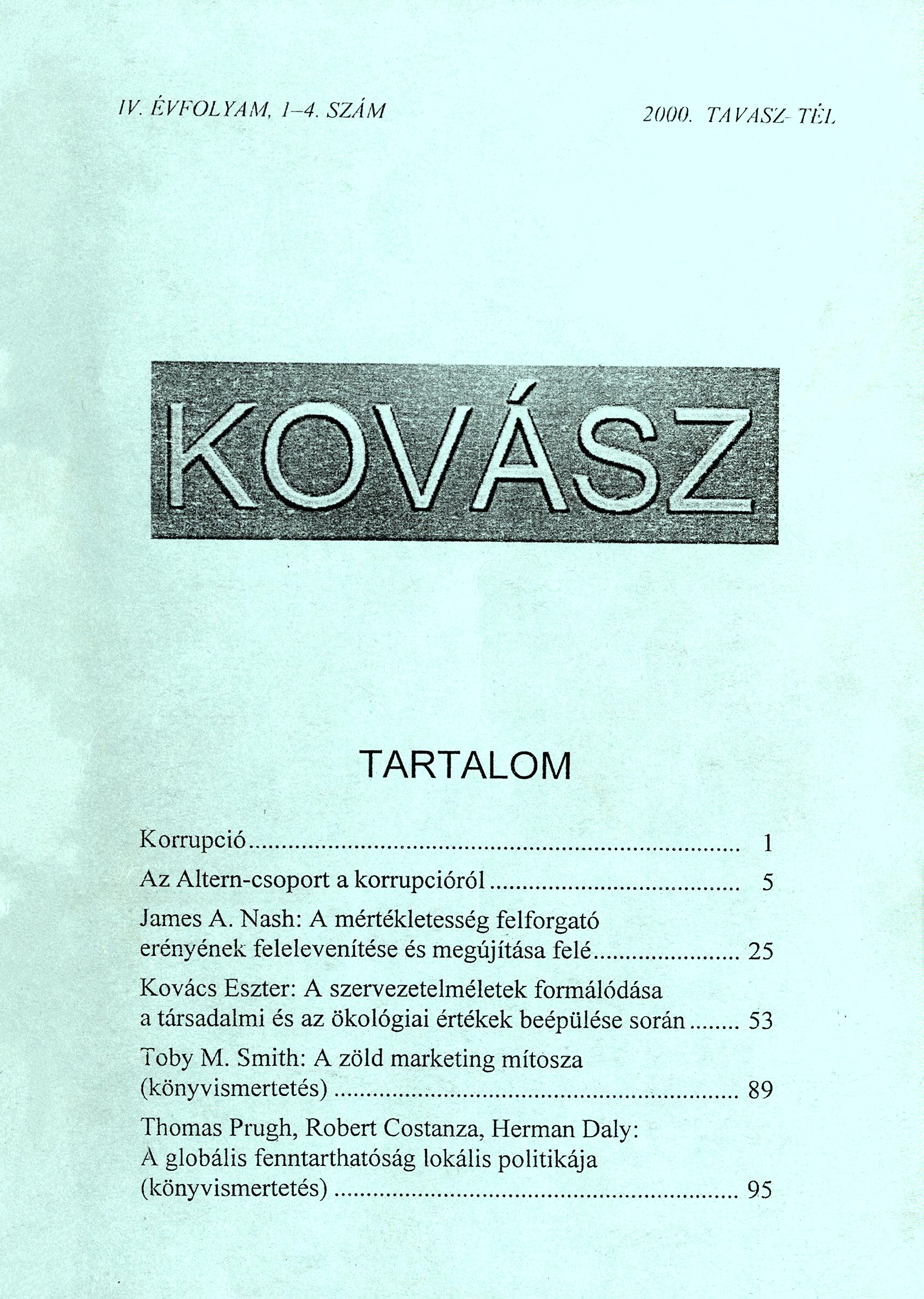
A szervezetelméletek formálódása a társadalmi és az ökológiai értékek beépülése során
DOI:
https://doi.org/10.14267/kov.2000e3Kulcsszavak:
antropocentrizmus, döntéshozatal, etika, felelősség, fenntarthatóság, környezet (természeti), környezetvédelem, közgazdaságtan, kutatás, menedzsment, rendszerszemlélet, stakeholder, survey, szennyezésmegelőzés, szervezet, szervezetelmélet, társadalom, termékgondnokság, vállalat, vezetésAbsztrakt
A szervezetekkel foglalkozó elméleti szakirodalom általában nem sokat törődik azzal, hogy a vállalat társadalmi és természeti/ökológiai környezetben működik. Ez nem véletlen, hiszen a szervezetelméletek az uralkodó közgazdasági irányzatok elképzelésein alapulnak, ahol a legfőbb cél a nyereség maximalizálása. Ebben a szemléletben az emberi és az ökológiai értékek idegen elemként jelennek meg, illetve csak az a kérdés, hogy követésük miként hat az elsődlegesnek tekintett (gazdasági jellegű) cél megvalósulására. Napjainkban azonban a vállalatok működésének társadalmi és ökológiai hatásai annyira jelentőssé váltak, hogy érdemes a vállalat szerepét a nagyobb rendszerek szempontjából átértékelni.
E tanulmányban a gazdaságnak a társadalommal, illetve a természeti környezettel való kapcsolatát tárgyaló közgazdasági elméletekből indulok ki, s a felvázolt rendszerből levezetem a lehetséges szervezetelméleti irányzatokat. Szervezeti szinten, mintegy fejlődési vonalként, részletesen bemutatom a vállalatok és a társadalom, illetve a vállalatok és a természeti környezet kapcsolatát tárgyaló megközelítéseket. A vizsgálat elvezet ahhoz a vállalatmodellhez, amelybe a társadalmi (emberi) és az ökológiai értékek egyaránt beépülnek. A rendszerszemlélet így egyenlővé válik az értékszemlélettel, s egyértelmű lesz, hogy az értékek iránti elkötelezettség jelenti az igazi felelős viselkedést.
A tanulmány remélhetőleg hozzájárul ahhoz a párbeszédhez, amely a vállalatok szerepéről és feladatairól indult meg a szervezetekkel foglalkozó kutatók körében, s gondolatokat ébreszt más tudományágak képviselőiben is.
Hivatkozások
Ackerman, R. W. - Bauer, R. A. [1976]: Corporate Social Responsiveness; Reston, Virginia, Reston Publishing
Aupperle, K. E. - Carroll, A. B. - Hatfield, J. D. [1985]: An Empirical Examination of the Relationship between Corporate Social Responsibility and Profitability; Academy of Management Journal 28 (2), 446-463. o.
Baranyi Á. [1999]: Erkölcsi és gazdasági megfontolások a vállalati környezetvédelemben; Kovász, tavasz-nyár, 50-68. o.
Berkes, F. - Folke, C. [1992]: Commentary: A Systems Perspective on the Interrelations between Natural, Human-made and Cultural Capital; Ecological Economics 5, 1-8. o.
Boda Zs. [1997]: A vállalat társadalmi felelőssége; in. Boda Zs. - Radácsi L. (szerk.): Vállalati etika; BKE Vezetőképző Intézet, Budapest, 1997, 10-25. o.
Boda Zs. - Radácsi L. (szerk.) [1997]: Vállalati etika; BKE Vezetőképző Intézet, Budapest
Bowen, H. R. [1953]: Social Responsibility of the Businessman; New York, Harper and Row
Bowie, N. [1991]: New Directions in Corporate Social Responsibility; Business Horizons, július-augusztus, 56-65. o.
Brenner, S. N. [1995]: Stakeholder Theory of the Firm, Its Consistencies with Current Management Techniques; in. Nasi, J. (szerk.) [1995]: Understanding Stakeholder Thinking; LRS publ. Helsinki, Finland, 75-95. o.
Buchholz, R. A. [1991]: Corporate Responsibility and the Good Society: from Economics to Ecology; Business Horizons, július-augusztus, 19-31. o.
Carroll, A. B. [1979]: A Three Dimensional Conceptual Model of Corporate Performance; Academy of Management Review 4., 479-505. o.
Carroll, A. B. [1987]: In Search of the Moral Manager; Business Horizons, március-április, 7-15. o.
Carroll, A. B. [1989]: Business and Society: Ethics and Stakeholder Management; Cincinatti, South-Western
Carroll, A. B. [1991]: The Pyramid of Corporate Social Responsibility: Toward the Moral Management of Organizational Stakeholders; Business Horizons, július-augusztus, 39-48. o.
Carroll, A. B. [1993]: Business and Society: Ethics and Stakeholder Management; Cincinatti, South-Western
Chamberlain, N. W. [1973]: The Limits of Corporate Responsibility; New York, Basic Books
Chikán A. (szerk.) [1997]: Vállalatgazdaságtan; Aula, Budapest
Clarkson, M. B. E. [1988]: Corporate Social Performance in Canada, 1976-1986; in. Preston, L. E. (szerk.): Research in Corporate Social Performance and Policy; Vol. 10, Greenwich CT. JAI Press, 241-265. o.
Clarkson, M. B. E. [1994]: A Risk Based Model of Stakeholder Theory; Proceedings of the Second Toronto Conference on Stakeholder Theory, Toronto, Centre for Corporate Social Performance and Ethics, University of Toronto
Clarkson, M. B. E. [1995]: A Stakeholder Framework for Analyzing and Evaluating Corporate Social Performance; Academy of Management Review, Vol. 20. No.1., 92-117. o.
Cleveland, C. J. [1997]: Biophysical Economics: From Physiocracy to Ecological Economics and Industrial Ecology; Department of Geography and Center for Energy and Environmental Studies, Boston University
Colby, M. E. [1991]: Environmental Management in Development: The Evolution of Paradigms; Ecological Economics 3, 193-213. o.
Costanza, R. (szerk.) [1991]: Ecological Economics: The Science and Management of Sustainability; Columbia University Press, New York
Cropper, M. L. - Oates, W. E. [1992]: Environmental Economics: A Survey; Journal of Economic Literature 30, június, 675-740. o.
Csutora M. [1998]: Az alkalmazkodás környezetvédelmi stratégiája - a hiányzó láncszem a vállalati környezeti stratégiák értelmezéséhez; doktori disszertáció, Budapesti Közgazdaságtudományi Egyetem
Csutora M. [1999]: Mérhető-e a vállalati környezetvédelmi teljesítmény?; Gazdaság-Vállalkozás-Vezetés, Műhelytanulmányok, 1. szám, 68-80. o.
Davis, K. [1973]: The Case for and against Business Assumption of Social Responsibility; Academy of Management Journal 16, 312-322. o.
Davis, K. - Blomstrom, R. L. [1975]: Business and Society: Environment and Responsibility; McGraw-Hill Book Company, New York
Donaldson, T. [1982]: Corporation and Morality; Prentice-Hall, Englewood Cliffs, New Jersey
Donaldson, T. - Preston, L. E. [1995]: The Stakeholder Theory of the Corporation: Concepts, Evidence and Implications; Academy of Management Review, Vol. 20. No.1., 65-91. o.
Etzioni, A. [1988]: The Moral Dimension: Toward a New Economics; New York, Free Press
Etzioni, A. [1992]: The I and We paradigm; in. Ekins, P. - Max Neef, M. (szerk.): Real-Life Economics; Routledge, London, New York, 48-53. o., magyarul: A "személy a közösségben" paradigma; in. Kindler J. - Zsolnai L. (szerk.): Etika a gazdaságban; Keraban, Budapest, 1993, 57-64. o.
Evan, W. M. - Freeman, R. E. [1988]: A Stakeholder Theory of the Modern Corporation: Kantian Kapitalism; in. Beachamp, T. L. - Bowie, N. L. (szerk.): Ethical Theory and Business; Prentice-Hall, Englewood Cliffs, New Jersey, harmadik kiadás, magyarul: A modern vállalat stakeholder elmélete: kantiánus kapitalizmus; in. Boda Zs. - Radácsi L. (szerk.): Vállalati etika; BKE Vezetőképző Intézet, Budapest, 1997, 93-124. o.
Fisher, A. C. - Peterson, F. M. [1976]: The Environment in Economics: A Survey; Journal of Economic Literature, Vol. 14, No. 1, 1-33. o.
Fischer, D. W. [1983]: Strategies Toward Political Pressures: A Typology of Firm's Responses; Academy of Management Review, január, 71-78. o.
Florida, R. [1996]: Lean and Green: The Move to Environmentally Conscious Manufacturing; California Management Review, Vol. 39, No.1., ősz, 90-105. o.
Frederick, R. E. - Hoffman, W. M. [1995]: Environmental Risk Problems and the Language of Ethics; Business Ethics Quarterly, Vol. 5. No.4., 699-711. o.
Frederick, W. C. [1978]: From SCR1 to SCR2, The Maturing of Business and Society Thought; Working paper 279, Graduate School of Business, University of Pittsburgh, újranyomva in. Business and Society, Vol. 33. No. 2., augusztus, 1994, 150-164. o.
Frederick, W. C. [1986]: Toward CSR3: Why Ethical Analysis is Indispensable and Unavoidable in Corporate Affairs?; California Management Review, Vol. 28, No. 2. tél, 126-141. o.
Frederick, W. C. [1987]: Theories of Corporate Social Performance; in. Sethi, S. P. - Falbe, C. M.: Business and Society, Dimensions of Conflict and Cooperation; New York, Lexington Books, 1987, 142-161. o.
Freedman, M. - Jaggi, B. [1982]: Pollution Disclosures, Pollution Performance and Economic Performance; OMEGA, Vol. 10. No. 2., 167-176. o.
Freeman, R. E. [1984]: Strategic Management: A Stakeholder Approach; Boston, Pitman, a 3. fejezet magyar fordítása: Stakeholder-menedzsment; in. Kindler J. - Zsolnai L. (szerk.) [1993]: Etika a gazdaságban; Keraban Kiadó, Budapest, 169-191. o.
Freeman, R. E. [1994]: The Politics of Stakeholder Theory: Some Future Directions; Business Ethics Quarterly, Vol. 4. No.4, 409-421. o.
Freeman, R. E. [1995]: Stakeholder Thinking: The State of the Art; in. Nasi, J. (szerk.): Understanding Stakeholder Thinking; LRS publications, Helsinki, Finland, 35-46. o.
Freeman, R. E. - Liedtka, J. [1991]: Corporate Social Responsibility: A Critical Approach; Business Horizons, július-augusztus, 92-98. o.
Friedman, M. [1962]: Capitalism and Freedom; Chicago, University of Chicago Press, magyarul: Kapitalizmus és szabadság; Akadémiai Kiadó, Budapest, 1996
Friedman, M. [1970]: The Social Responsibility of Business Is to Increase its Profits; The New York Times Magazine, szeptember 13., 32-33., 122-126. o.
Gompel, J. V. [1999]: Who Wins the Nobel Prize? - How Fair is the Nobel?; Challenge, Vol. 42, No. 2. március-április, 33-40. o.
Goodpaster, K. E. [1991]: Business Ethics and Stakeholder Analysis; Business Ethics Quarterly 1 (1), 53-73. o.
Griffin, H. J. - Mahon, J. F. [1997]: The Corporate Social Performance and Corporate Financial Performance Debate, Twenty Five Years of Incomparable Research; Business and Society, Vol. 36, No. 1., március, 5-31. o.
Hart, S. L. [1995]: A Natural-resource-based View of the Firm; Academy of Management Review, Vol. 20, No. 4., 986-1014. o.
Hart, S. L. [1997]: Beyond Greening: Strategies for a Sustainable World; Harvard Business Review, január-február, 67-76. o.
Hill, Ch. W. L. - Jones, T. M. [1992]: Stakeholder-Agency Theory; Journal of Management Studies, Vol. 29, No. 2., március, 131-155. o.
Hoffman, W. M. [1991]: Business and Environmental Ethics; Business Ethics Quarterly 1./2., 169-184. o., magyarul: Gazdasági és környezeti etika; in. Boda Zs. - Radácsi L. (szerk.): Vállalati etika; BKE Vezetőképző Intézet, Budapest, 1997, 62-78. o.
Hunt, C. B. - Auster, E. R. [1990]: Proactive Environmental Management; Sloan Management Review, tél, 7-18. o.
Jennings, P. D. - Zandbergen, P. A. [1995]: Ecologically Sustainable Organizations: An Institutional Approach; Academy of Management Review, Vol. 20., No. 4., 1015-1052. o.
Jones, T. M. [1995]: Instrumental Stakeholder Theory: A Synthesis of Ethics and Economics; Academy of Management Review, Vol. 20, No.2. 404-437. o.
Keely, M. [1988]: A Social-Contact Theory of Organizations; University of Notre Dame Press, Notre Dame, Indiana
Keim, G. [1981]: Foundations for the Political Strategy of Business; California Management Review, tavasz, 41-48. o.
Kerekes S. - Kindler J. (szerk.) [1997]: Vállalati környezetmenedzsment; Aula, Budapest
Kerekes S. - Rondinelli, D. - Vastag Gy. [1995]: A vállalatok környezeti kockázatai és a vállalatvezetők felelőssége - Milyen az ideális menedzsment?; Közgazdasági Szemle, 9. sz., 882-895. o.
Kerekes S. - Szlávik J. [1996]: A környezeti menedzsment eszközei; Közgazdasági és Jogi Könyvkiadó, Budapest
Kindler J. - Zsolnai L. (szerk.) [1993a]: Etika a gazdaságban; Keraban Kiadó, Budapest
Kindler J. - Zsolnai L. (szerk.) [1993b]: A közgazdaságtan társadalmi és etikai vetületei; Egyházfórum, Budapest
Kocsis T. [1999a]: Emberközpontú fejlődés; Valóság, 4. sz., 15-38. o.
Kocsis T. [1999b]: A jövő közgazdaságtana?; Kovász, ősz, 131-164. o.
Mason, E. S. [1960]: The Corporation in Modern Society; Cambridge, Massachusetts: Harvard University Press
McAdam, T. W. [1973]: How to Put Corporate Responsibility into Practice; Business and Society Review/Innovation, nyár, 8-16. o.
McGuire, J. W. [1963]: Business and Society; New York, McGraw-Hill
Miles, R. H. [1987]: Managing the Corporate Social Environment; Englewood Cliffs, NJ., Prentice-Hall
Mitchell, R. K. - Agle, B. R. - Wood, D. J. [1997]: Toward a Theory of Stakeholder Identification and Salience: Defining the Principle of Who and What Really Counts; Academy of Management Review, Vol. 22, No. 4., 853-886. o.
Pataki Gy. [1999]: A vállalatok "zöldülése" mint tanulási folyamat; Kovász, tavasz-nyár, 69-97. o.
Pataki Gy. [2000]: Az ökológiailag fenntartható vállalat; Doktori értekezés tervezet, Budapesti Közgazdaságtudományi és Államigazgatási Egyetem, Vállalatgazdaságtan Tanszék
Pataki Gy. - Radácsi L. (szerk.) [2000]: Alternatív kapitalisták - Gazdálkodás az érintettek jóllétéért; Új Paradigma Kiadó, Szentendre
Pearce, D. W. - Turner, R. K. [1990]: Economics of Natural Resources and the Environment; The John Hopkins University Press, Baltimore
Perrow, Ch. [1986]: Complex Organizations - A Critical Essay; McGraw-Hill Inc., New York, magyarul: Szervezetszociológia; Osiris Kiadó, Budapest, 1997
Pfeffer, J. - Salancik, G. [1978]: The External Control of Organizations; New York, Harper and Row
Polányi K. [1957]: A gazdaság mint intézményesített folyamat; in. Polányi K.: Az archaikus társadalom és a gazdasági szemlélet; Gondolat Kiadó, 1976, 228-273. o.
Porter, M. E. [1980]: Competitive Strategy; New York, Free Press
Porter, M. E. - van der Linde, C. [1995a]: Toward a New Conception of the Environment-Competitiveness Relationship; Journal of Economic Perspectives, Vol. 9., No. 4, ősz, 97-118. o.
Porter, M. E. - van der Linde, C. [1995b]: Green and Competitive; Harvard Business Review, szeptember-október, 120-134. o.
Post, J. E. [1978]: Corporate Behaviour and Social Change; Reston, VA, Reston Publishing
Post, J. E. - Frederick, W. C. - Lawrence, A. T. - Weber, J. [1996]: Business and Society, Corporate Strategy, Public Policy, Ethics; New York, McGraw Hill
Preston, L. E. - O'Bannon, D. P. [1997]: Research Note: The Corporate Social-financial Performance Relationship - A Typology and Analysis; Business and Society, Vol. 36, No. 4. 419-429. o.
Preston, L. E. - Post, J. E. [1975]: Private Management and Public Policy; Englewood Cliffs, NJ, Prentice Hall
Preston, L. E. - Post, J. E. [1981]: Private Management and Public Policy; California Management Review 23 (3) 56-62. o.
Purser, R. E. - Park, Ch. - Montuory, A. [1995]: Limits to Anthropocentrism: Toward an Ecocentric Organizational Paradigm?; Academy of Management Review, Vol. 20, No. 4., 1053-1089. o.
Radácsi L. [1997]: A vállalatok stakeholder elmélete; in. Boda Zs. - Radácsi L. (szerk.): Vállalati etika; BKE Vezetőképző Intézet, Budapest, 1997, 79-92. o.
Radácsi L. [1998a]: Az arisztoteliánus gazdaságetika alapjai; Kovász, tavasz, 24-29. o.
Radácsi L. [1998b]: A szervezeti etika arisztoteliánus értelmezése, az etika szervezeti intézményesítésének jelentősége és módszerei; Ph.D. tézisjavaslat, Budapesti Közgazdaságtudományi Egyetem, Vállalatgazdaságtan Tanszék, Gazdaságetikai Központ
Reinhardt, F. L. [1998]: Environmental Product Differentiation: Implications for Corporate Strategy; California Management Review, Vol. 40., No. 4., nyár, 43-73. o.
Roman, R. M. - Hayibor, S. - Agle, B. R. [1999]: The Relationship between Social and Financial Performance, Repainting a Portrait; Business and Society, Vol. 38. No.1., március, 109-125. o.
Rostow, E. V. [1959]: To Whom and for What Ends Is Corporate Management Responsible; in. Mason, E. S. (szerk.): The Corporation in Modern Society; Harvard University Press, Cambridge, 1960, 46-72. o.
Sahu, N. Ch. - Nayak, B. [1994]: Niche Diversification in Environmental /ecological Economics; Ecological Economics 11, 9-19. o.
Savage, G. T. - Nix, T. H. - Whitehead, C. J. - Blair, J. D. [1991]: Strategy for Assessing and Managing Organizational Stakeholders; Academy of Management Executive 5 (2), 61-75. o.
Schumacher, E. F. [1980]: Small Is Beautiful; Century Hutchinson Publishing Group Limited, London, magyarul: A kicsi szép - Tanulmányok egy emberközpontú közgazdaságtanról; Közgazdasági és Jogi Könyvkiadó, Budapest, 1991
Sethi, S. P. [1979]: A Conceptual Framework for Environmental Analysis of Social Issues and Evaluation of Business Response Patterns; Academy of Management Review, Vol. 4, No. 1., 63-74. o.
Sethi, S. P. - Falbe, C. (szerk.) [1987]: Business and Society - Dimensions of Conflict and Cooperation; New York, Lexington Books
Shane, P. - Spicer, B. [1983]: Market Response to Environmental Information Produced Outside the Firm; The accounting Review, Vol. 58, No. 3, 521-538. o.
Shrivastava, P. [1995a]: The Role of Corporations in Achieving Ecological Sustainability; Academy of Management Review, Vol. 20, No. 1., 936-960. o.
Shrivastava, P. [1995b]: Ecocentric Management for a Risk Society; Academy of Management Review, Vol. 20, No. 1., 118-137. o.
Smith, G. A. [1996]: Humanist Economics: From Homo Economicus to Homo Sapiens; in. Foldvary, F. H. (szerk.): Beyond Neoclassical Economics - Heterodox Approaches to Economic Theory; Edwar Elgar, Cheltenham, UK, Brookfield, US, 1996, 115-134. o.
Söderbaum, P. [1999]: Values, Ideology and Politics in Ecological Economics; Ecological Economics 28, 161-170. o., magyarul: Értékek, ideológia és politika az ökológiai közgazdaságtanban; in. Kovász, ősz, 115-130. o.
Starik, M. [1995]: Should Trees Have Managerial Standing? Toward Stakeholder Status for Non-human Nature; Journal of Business Ethics, Vol. 14, 207-217. o.
Steger, U. [1993]: The Greening of the Board Room: How German Companies Are Dealing with Environmental Issues; in. Fisher, J. - Shot, K. (szerk.): Green Strategies for Industry; Washington, DC, Island Press, 147-166. o.
Steiner, G. A. [1975]: Business and Society; New York, Random House
Sturdivant, F. D. [1985]: Business and Society, a Managerial Approach; Irwin, Homewood, Illinois
Swanson, D. L. [1995]: Addressing a Theoretical Problem by Reorienting the Corporate Social Performance Model; Academy of Management Review, Vol. 20, No. 1., 43-64. o.
Ullmann, A. A. [1985]: Data in Search of a Theory: A Critical Examination of the Relationships Among Social Performance, Social Disclosure, and Economic Performance of U.S. Firms; Academy of Management Review, Vol. 10, No. 3., 540-557. o.
Waddock, S. A. - Graves, S. B. [1997]: Quality of Management and Quality of Stakeholder Relations; Business and Society, Vol. 36, No. 3, szeptember, 250-279. o.
Walgenbach, P. [1996]: Intézményi megközelítések a szervezetelméletben; magyar fordítás kéziratban, Budapesti Közgazdaságtudományi és Államigazgatási Egyetem, Vezetési és Szervezési Tanszék
Walley, N. - Whitehead, B. [1994]: It's Not Easy Being Green; Harvard Business Review, május-június, 46-52. o.
Wartwick, S. L. - Cochran, P. L. [1985]: The Evolution of the Corporate Social Performance Model; Academy of Management Review, Vol. 10, No. 4., 758-769. o.
Welford, R. (szerk.) [1996]: Corporate Environmental Management - Systems and Strategies; Earthscan Publications Ltd., London
Wicks, A. C. - Gilbert, D. R. - Freeman, R. E. [1994]: A Feminist Reinterpretation of the Stakeholder Theory; Business Ethics Quarterly 4 (4), 475-497. o.
Wilson, I. [1975]: What One Company is Doing about Today's Demand on Business; in. Steiner, G. A. (szerk.): UCLA Conference on Changing Business-Society Relationship, Los Angeles, Graduate School of Management, UCLA, 1975
Wood, D. J. - Jones, R. E. [1995]: Stakeholder Mismatching: a Theoretical Problem in Empirical Research on Corporate Social Performance; The International Journal of Organizational Analysis, Vol. 3, No. 3., 229-267. o.
Wood, D. J. [1990]: Business and Society; Glenview, IL, Scott Foresman (Harper Collins)
Zucker, L. G. [1987]: Institutional Theories of Organizations; Annual Review of Sociology 13, 443-464. o.
Zsolnai L. [1987]: Mit ér az ökonómia, ha magyar?; Közgazdasági és Jogi Könyvkiadó, Budapest
Zsolnai L. [1989]: Másként gazdálkodás; Közgazdasági és Jogi Könyvkiadó, Budapest
Letöltések
Megjelent
Folyóirat szám
Rovat
License
Copyright (c) 2000 Kovász

This work is licensed under a Creative Commons Attribution 4.0 International License.