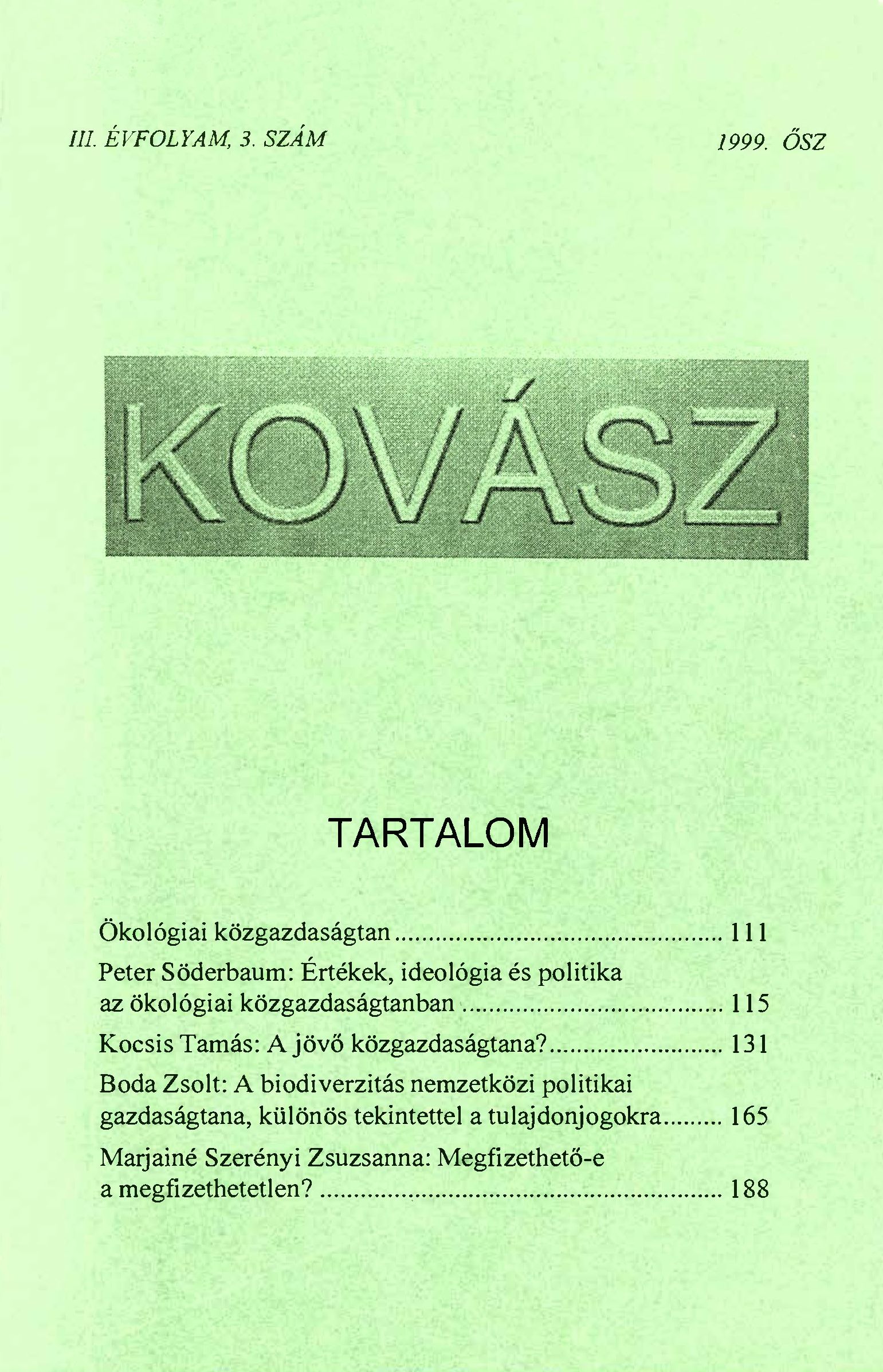
Peter Söderbaum: Értékek, ideológia és politika az ökológiai közgazdaságtanban
DOI:
https://doi.org/10.14267/kov.19993e1Kulcsszavak:
döntéshozatal, etika, fejlődés, fenntarthatóság, ideológia, institucionalizmus, környezet, közgazdaságtan, kutatás, ökológia, politika, racionalitás, stakeholder, szervezet, tudomány, vállalatAbsztrakt
Az ökológiai közgazdaságtan olyan értékelkötelezett tudomány, amely környezeti témákat vizsgál és konstruktívan segíti a fenntarthatóbb fejlődési pályára állást. Ugyanakkor úgy látszik, hogy számos ökológiai közgazdász még mindig vonakodik az egyéb iskoláktól való eltávolodástól, ha értékekkel és ideológiával kapcsolatos témák nyílt megfogalmazásáról van szó. E rövid tanulmány tárgya a kutatói beállítottság, valamint ennek értékekkel és ideológiával való összefüggése. Az írás feltárja, hogy nemcsak a tudósokat, hanem a társadalom tagjait is befolyásolja az általuk vallott „ideológiai irányultság". Ennek alapján állapítja meg azt, hogy a gazdasági emberre, illetve a „profitmaximalizáló vállalatra" vonatkozó feltételezések egynémely gyengesége mérsékelhető, ha bevezetjük a Politikai Gazdasági Személy (Political Economic Person), valamint a Politikai Gazdasági Szervezet (Political Economic Organisation) fogalmát.
Hivatkozások
Costanza, R. (1989): What is ecological economics?; Ecological Economics 1 (1), 1-7. o.
Costanza, R. (1997): Frontiers in Ecological Economics: Transdisciplinary Essays by R. Costanza; Edward Elgar, Cheltenham
Costanza, R. - Cumberland, J. - Daly, H. - Goodland, R. - Norgaard, R. (1997): An Introduction to Ecological Economics; St. Lucie Press, Boca Raton FL
Daly, H. - Cobb, J. R. Jr. (1989): For the Common Good. Redirecting the Economy toward Community, the Environment and a Sustainable Future; Beacon Press, Boston
Etzioni, A. (1988): The Moral Dimension. Toward a New Economics; The Free Press, New York
Ford, D. (szerk.) (1990): Understanding Business Markets. Interaction, Relationships, Networks; Academic Press, London
Glasser, H. (1998): On the evaluation of 'wicked problems'. Guidelines for integrating qualitative and quantitative factors in environmental policy analysis; in. Lichfield, N. - Barbanente, A. - Borri, D. - Khakee, A. - Prat, A. (szerk.): Evaluation in Planning. Facing the Challenge of Complexity; Kluwer, Dordrecht
Håkansson, H. - Snehota, I. (szerk.) (1995): Developing Relationships in Business Networks; Routledge, London
Korten, D. C. (1995): When Corporations Rule the World; Kumarian Press, West Hartford; magyarul: Tőkés társaságok világuralma; Kapu Kiadó, Budapest, 1996
Krishnan, R. - Harris, J. M. - Goodwin, N. R. (szerk.) (1995): A Survey of Ecological Economics (Frontier Issues in Economic Thought); Island Press, Washington DC
March, J. G. (1994): A Primer in Decision Making; The Free Press, New York
Morgan, G. (1986): Images of Organization; SAGE, London
Myrdal, G. (1978): Institutional Economics; Journal of Economic Issues 12 (4), 771-783. o.
Norgaard, R. B. (1989): The case for methodological pluralism; Ecological Economics 1 (1), 37-57. o.
Norgaard, R. B. (1994): Development Betrayed. The End of Progress and a Coevolutionary Revisioning of the Future; Routledge, London
North, D. C. (1990): Institutions, Institutional Change and Economic Performance; Cambridge University Press, Cambridge
Perkins, E. (szerk.) (1997): Women, ecology and economics; Ecological Economics 20 (különkiadás), 105-185. o.
Sagoff, M. (1988): The Economy of the Earth. Philosophy, Law and the Environment; Cambridge University Press, Cambridge
Sagoff, M. (1998): Aggregation and deliberation in valuing environmental public goods: a look beyond contingent pricing; Ecological Economics 24, 213-230. o.
Sen, A. (1987): On Ethics in Economics; Basil Blackwell, New York
Simon, H. A. (1976): Administrative Behaviour; 3. kiadás, The Free Press, New York
Simon, H. A. (1983): Reason in Human Affairs; Basil Blackwell, London
Söderbaum, P. (1992): Neoclassical and institutional approaches to development and the environment; Ecological Economics 5, 127-144. o.
Söderbaum, P. (1998a): Valuation as part of a microeconomics for ecological sustainability; in. O'Connor, M. - Spash, C. (szerk.): Valuation and the Environment. Theory, Method and Practice; Edward Elgar, Cheltenham, 85-105. o.
Söderbaum, P. (1998b): Ecological Economics. A Political Economics Approach to Environment and Development (könyv kézirata)
Vedeld, P. O. (1994): The environment and interdisciplinarity. Ecological and neoclassical economic approaches to the use of natural resources; Ecological Economics 10 (1), 1-13. o.
Letöltések
Megjelent
Folyóirat szám
Rovat
License
Copyright (c) 1999 Kovász

This work is licensed under a Creative Commons Attribution 4.0 International License.